


In Bangladesh, the Ready-Made Garments (RMG) sector is thriving as it contributes approximately 84% of the country’s total export earnings (investbangladesh). Knitwear manufacturing- an integral aspect of RMG manufacturing in Bangladesh- is driven by resource sourcing, cost efficiency, green production, global logistics advantages, and skilled workers. However, the unsung hero who contributes to success is a merchandiser.
A merchandiser is considered the central nervous system of manufacturing. They make the cost of an order and, at times, hold communication with clients. But the one area that determines the true caliber of any merchandiser is their ability to make accurate costing for an order.
Merchandisers bring strong expertise and experience to their roles. In a complex and fast-moving knitwear environment, occasional challenges can naturally give rise to unintended mistakes—not due to lack of skill, but because of the dynamic nature of operations
In this blog, we will look into the major costing concerns of knitwear merchandisers in Bangladesh.
Let’s dive into the explanation!
Costing Concerns of Knitwear Merchandisers in Bangladesh
Merchandisers play a critical role in determining an order’s profitability. The costing they make for any order heavily depends on accurate yarn consumption and production cost.
A single mistake in determining the cost to make an order can result in significant financial losses for the factory.
Thus, merchandisers have a set of concerns that actually amplifies the possibility of costly costing errors.
Let’s look into some of those concerns in detail.
1. Heavy reliance on Excel for knitwear costing
In many knitwear factories, costing is still handled through separate Excel files for each style, where merchandisers often depend on memorized formulas or copied costing sheets from previous orders. While this approach seems efficient, it creates risk when styles change or revisions are required.
Excel works well for calculations, but knitwear costing is highly dynamic and collaborative. Managing multiple styles, buyers, and frequent changes across teams quickly exposes Excel’s limitations.
The core issue is not calculation accuracy, but process control. Even with Online Excel, there is no role-based control, order-level linkage across styles, or clear visibility of which costing is approved. As a result, updates get missed, inconsistencies appear, and costing errors reach the shop floor.
All in all, Excel may be a helpful tool, but its limitation hints towards opting for a solution for better digital transformation in knitwear manufacturing.
2. Separate files for costing each style
In many knitwear factories, costing for each style is maintained in a separate Excel file. It becomes problematic when a single order contains multiple styles, colorways, or size variations. Each style exists in isolation, with no direct linkage to the overall order. The impact of this fragmented approach is confusion and inconsistency.
When revisions are required—due to buyer feedback, yarn changes, or cost negotiations—updates may be applied to one Excel file but missed in others. This leads to multiple versions of costing floating across teams, approvals based on outdated data, and mismatches between approved costing and actual execution.
Over time, due to a lack of process control and visibility, costing errors can occur, which may reach the shop floor and eventually lead to margin leakage.
3. Manual handling and keeping records of vendors
Until buyers specifically request yarn or other materials from a preferred vendor, merchandisers typically select vendors from their network. These vendors often agree to discounts or steady rates based on informal agreements. However, issues arise when vendors later reject these terms during billing, citing missing documentation.
Such problems disrupt the costing process, forcing last-minute revisions and delaying approvals, which ultimately reduces profit margins. Merchandisers are left to manage unexpected costs without proper support, leading to diminished buyer trust. This creates a higher risk of order cancellations, particularly during peak seasons, and negatively impacts overall profitability.
Over time, these process gaps translate into major cost drivers. When prominent cost drivers and hidden costs of inefficiencies add up, they make a drastic impact on factory profitability.
4. Workload and superiority complexity of senior merchandisers
In knitwear manufacturing, effective coordination and collaboration across and within departments is essential. However, within merchandising teams, there are often unspoken challenges that affect smooth workflows.
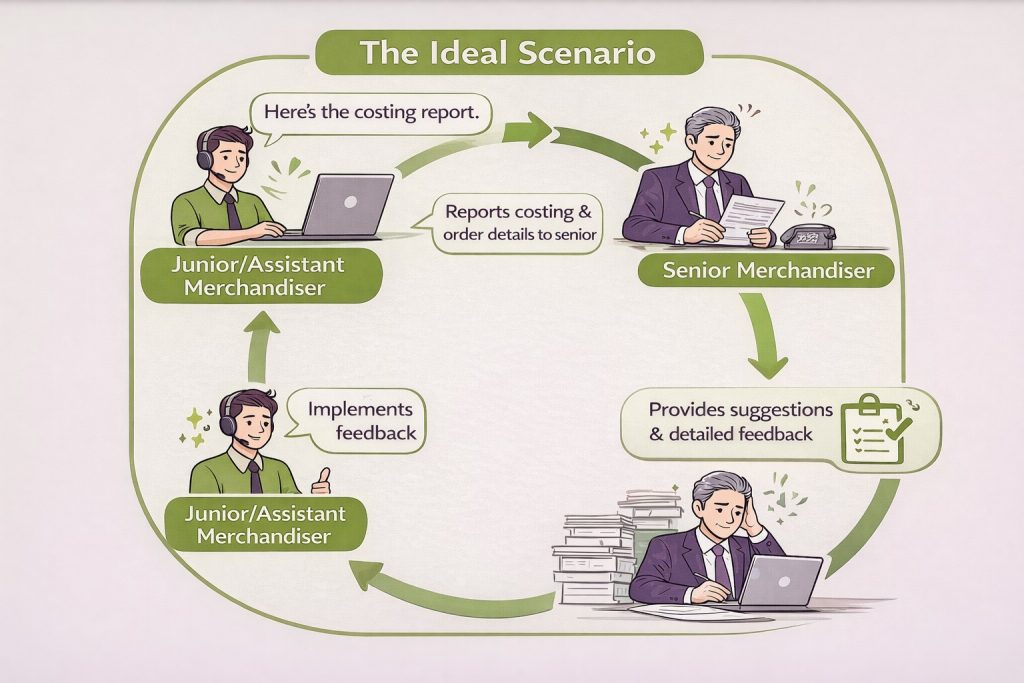
Most factories operate with a hierarchy of junior, mid-level, and senior merchandisers, where costing prepared by juniors must be reviewed and approved by seniors before moving forward for buyer negotiation or production planning.
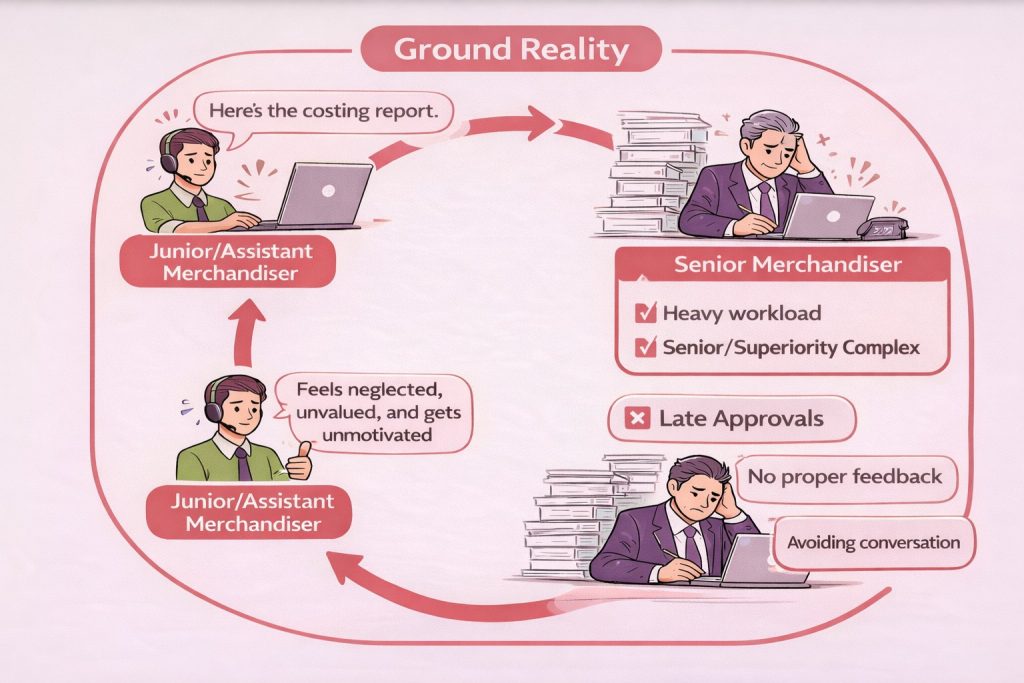
Due to heavy workloads, limited availability, and at times a perceived superiority complex, senior merchandisers may not always provide the level of support or engagement required.
This can result in delayed approvals, limited guidance, or revisions that lack clarity. Consequently, costing decisions may become delayed or distorted, creating bottlenecks and slowing down overall decision-making within the factory.
Here is a visual representation of how the ideal and real scenarios are in the costing department of the knitwear factory.
So, what can be the best solution to make the costing process in knitwear manufacturing more accurate, streamlined, and controlled? Well, it can be an ERP. Not just any generic ERP, but a tailored ERP for knitwear manufacturing, which is KnitOne.
KnitOne has various solutions dedicated to solving core cost-driving issues of the industry. Among them, the costing caters to the merchandising team.
Let’s now look into how the costing module addresses the above-mentioned concerns of the merchandisers.
How can KnitOne solve the costing issues of Bangladeshi merchandisers?
Let’s have a comparative look at how KnitOne addresses the costing concerns of knitwear merchandisers of Bangladesh.
| Costing Concerns | How KnitOne Addresses Them |
| 1. Heavy reliance on Excel for knitwear costing | No formula needed. Just enter the fields for costs and get your order costing within minutes. For more, check out the Costing Solution. |
| 2. Separate Excel Files for Costing Each Style | A centralized costing module allows multiple styles within an order to be costed on a single screen. |
| 3. Manual handling and record-keeping of vendors | With the vendor management feature, you can keep digital records of vendors, their pricing history, and material associations directly linked to costing. |
| 4. Workload and superior complexity of senior merchandisers | KnitOne’s Approval-Based Workflows ensure the senior merchandiser’s approval as the final point to release the costing to ensure coordination between the assistant and senior merchandisers. |
KnitOne’s Bonus Solution for Merchandiser
Merchandisers and relevant authorities can check the Order Balance Sheet in KnitOne.
Why? Because OBS (Order Balance Sheet) and costing are interconnected solutions. In OBS, they can have a clear view of estimated/target costs (set during costing) and the actual costs (after closing an order).
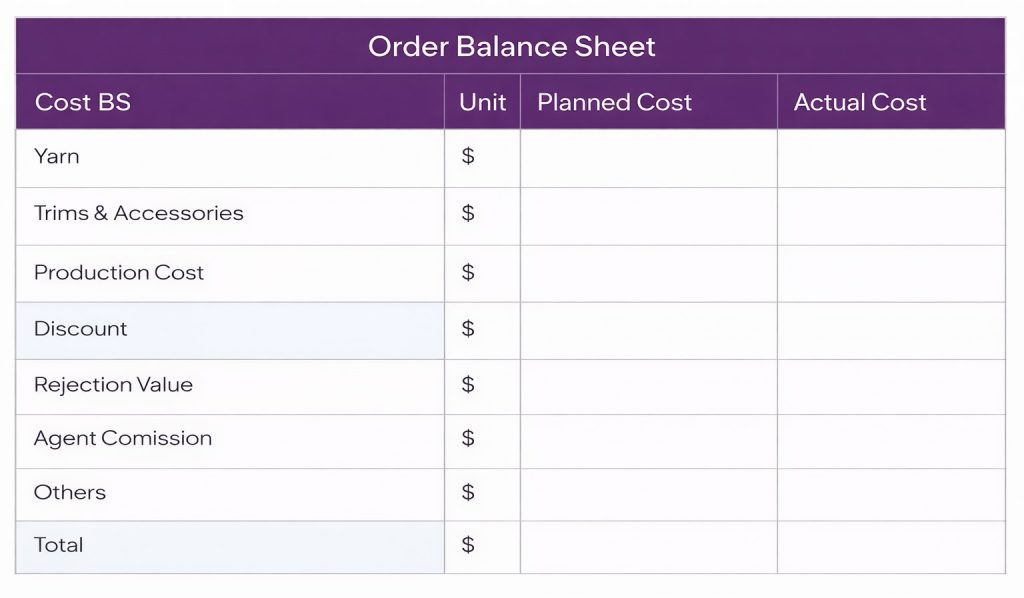
With this information, merchandisers can identify any costing issues, update future estimates accordingly, and coordinate with other departments to ensure alignment.
On the other hand, management can assess financial gain or loss from each order. They can analyze the overall impact on profitability, make strategic adjustments, and implement corrective actions.
Final Thoughts
Costing of knitwear garments often gets stuck—not because teams lack skill, but because the process itself depends too much on manual coordination.
Assistant merchandisers prepare the costing; seniors are expected to review it, and approvals move through emails, calls, or quick conversations. When workloads pile up, or responses get delayed, costing revisions slow down; negotiations pause, and decisions start to drag—quietly affecting margins and production timelines.
KnitOne solves this with approval-based workflows that ensure senior merchandiser approval is the final, clear step before costing is released. As an ERP Built Specifically for Knitwear Manufacturing, KnitOne embeds approvals directly into the system, improving coordination, speed, and accountability.
In short, KnitOne empowers knitwear manufacturers in Bangladesh with solutions built to meet the major and complex needs of flat-knit manufacturing.
Why wait? Boost Profits with KnitOne’s Complete Operational Visibility.
Frequently Asked Questions
Will KnitOne Replace Merchandisers?
No, KnitOne will not replace merchandisers. It will automate time-consuming tasks like costing, inventory management, and order tracking. This allows merchandisers to focus on more strategic activities.
Moreover, for merchandisers’ other responsibilities, such as negotiation, client communication, and production coordination, human expertise is needed.
All in all, KnitOne aids in improving efficiency and accuracy, while leaving critical decision-making and relationship management in the hands of merchandisers.
