


Did you know the Indian textile and apparel industry contributes 2.3% to GDP, 13% to industrial production, and 12% to exports. In fact, it is also the second largest employment generator, with over 45 million people.
India has always been a global powerhouse in knitwear, a true heartbeat of the textile industry. In addition, Tirupur is the hub for cotton knitwear and T-shirts, while Ludhiana is famous for woollen sweaters and winter knitwear.
And the good news is that the Indian knitwear manufacturing industry is set to soar. All thanks to the landmark ‘European Union (EU) and India-Free Trade Agreement (FTA) 2026.’ As per the agreement, Indian knitwear products can be exported to the European market with zero tariff.
In this blog, we will look into what the FTA 2026 has to offer and what efforts the sweater manufacturers should put in to earn maximum benefit.
Let’s start with what the tariff actually offers.
The Positive Impact of the FTA on Indian Knitwear Production
For decades, India’s knitwear industry was kept at arm’s length from Europe’s lucrative textile market, burdened by a 10-12% tariff. According to Economic Times, despite the EU’s $250 billion textile import market, India’s share stagnated at a mere $7 billion, overshadowed by zero-duty competitors like Bangladesh and Vietnam.
But this is going to change. Let’s look into what positive impact can be witnessed.
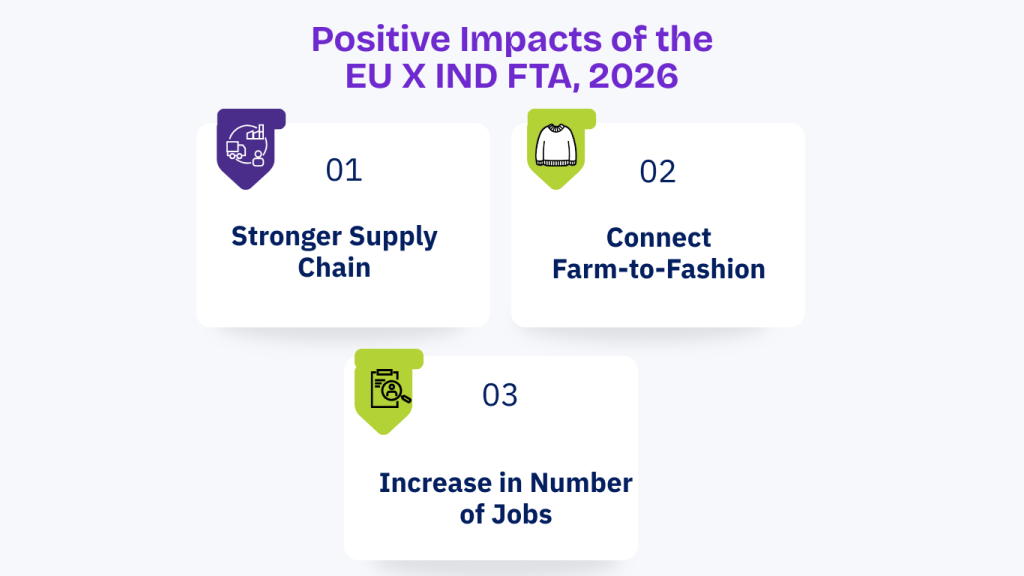
1. Stronger Supply chain
With the 2026 EU-India Free Trade Agreement (FTA), this narrative changes overnight. The removal of tariffs levels the playing field, allowing Indian textile exports to potentially surge to $30-$50 billion, according to expert predictions.
For established hubs like Tirupur and Ludhiana, this shift will mark a pivotal moment, transforming them into central players in a revamped global supply chain.
2. India’s Value Chain Advantage
But India’s true advantage goes beyond mere tariff relief. As per India Today Insight, the country boasts an unparalleled value chain, from cotton fields to finished garments—a “farm-to-fashion” ecosystem. This ensures total control over quality, traceability, and sustainability. For European buyers seeking reliable, ethically sourced products, India stands as the ideal partner.
3. Job Growth and Economic Empowerment
This is more than an economic shift; it’s a historic moment for India’s workforce. The FTA is expected to create 6-7 million new jobs, boosting regional economies and empowering women across the country. As India steps into this new era, the future of its knitwear industry has never been more promising.
Although it’s a positive opportunity for the country, the real deal is actually to utilize it.
The factory owners may have high-quality machines and top-class employees, but without digital transformation, it is going to be exceptionally difficult tap into that potential.
In addition, just Excel and computers aren’t enough for digital transformation in knitwear manufacturing. They need a robust system like an ERP.
Why Indian Knitwear Manufacturers Need ERP
ERP adoption in India has revolutionized industries like automotive and electronics.
Yet, in the knitwear sector, only a handful of factories have implemented ERP. This hesitation is rooted in traditional practices, resistance to new technology, and a fragmented industry structure.
With the FTA and global demands on the horizon, ERP is not just an upgrade—it’s an urgent necessity for staying competitive.
Here’s why ERP is essential for Indian knitwear manufacturers:
- To qualify for zero-duty access, manufacturers must prove their products are made entirely within India- a part of “Rules of Origin”.
An ERP system tracks the entire production process—from yarn to finished garment—ensuring full traceability and providing a digital “passport” for customs audits.
- India’s knitwear industry must match the speed and efficiency of global leaders. Manual systems cause delays and bottlenecks.
An ERP system synchronizes production across different hubs, optimizes inventory, and eliminates production slowdowns, keeping factories on track, and meeting tight deadlines.
But the question is ‘which ERP to choose from a pool of options?’ Definitely not Generic ERPs, and Obviously, KnitOne!
Let’s look into why KnitOne qualifies to be the apt ‘ERP for Indian Knitwear Manufacturing in India’.
Why KnitOne is the Best ERP for Sweater Manufacturing in India
KnitOne is a tailored ERP for knitwear manufacturing, which can capture the core data points from yarn to growth, all in one view.
Built from inputs of knitwear professionals and experts, KnitOne has numerous modules that solve the key issues of the operations.
Here is a table that briefly explains what KnitOne offers to the Indian knitwear manufacturers if they choose it as their own system.
| Manual-Based Discrepancies | KnitOne Solution/Module |
| Costing concerns of the Knitwear Merchandisers | Costing and Sales module provides instant costing for both samples and bulk orders, eliminating the need for manual calculations. |
| Production Planning without considering the shop floor reality | Production Planning and Control allows production managers to standardize the production cycle and base planning on real shop floor realities. |
| Lack of Operational Visibility for business owners. | Dashboard offers detailed graphs and heatmaps on WIP, production, CMT, and more, giving real-time operational visibility. |
| Heavy Yarn Wastage (especially significant for luxury yarn) | Yarn Inventory module tracks entire yarn movement and details, minimizing wastage by providing better control over material usage. |
| Employee Accountability in CMT | Worker efficiency module tracks completed tasks, rework, rejects, and overall performance, ensuring clear accountability. |
| Departmental Collaboration Gaps | Automated workflow improves communication, accountability, and task tracking across departments, enhancing collaboration. |
| Incomplete Order Performance Report | Order Balance Sheet tracks every aspect of an order from yarn procurement to final shipment, ensuring complete visibility and timely order completion. |
Also, factories can request custom features to address their specific concerns.
Final Thoughts
India’s knitwear industry is filled with potential, supported by skilled technicians, experienced merchandisers, and advanced machinery. With the EU-India Free Trade Agreement (FTA) of 2026 and zero tariffs on Indian materials, the growth opportunities are immense.
However, challenges remain. The issue isn’t with the workforce or operations, but rather the reliance on outdated, manual systems.
While these traditional methods may have been effective in the past, they may not be competent to meet the demands the FTA will bring. As global expectations rise, these legacy systems may struggle to keep up. Thus, digital transformation is no longer just an option; it’s a necessity for continued growth and success. By adopting an ERP system like KnitOne, manufacturers can streamline operations, improve collaboration, and make more informed decisions faster, setting themselves up for success in the global market.
Why wait? Boost Profits with KnitOne’s Complete Operational Visibility.
