


Knitwear, once a simple way to stay warm, now represents 17.4% of the global apparel market, with 1.9 billion consumers demanding comfortable, elastic, and sustainable garments (Source: Data Bridge Market Research )
What began as a practical craft has evolved into a thriving industry driven by innovation and changing consumer needs. As the industry grows, so do the challenges.
Surprisingly, many of these challenges lie within factories, slowing production, and hindering profitability.
In this blog, we will first look into the way the knitwear industry made progress, along with the present-day challenges and best solutions to address them.
Let’s study the the knitwear history first.
Knitwear Manufacturing Evolution: Past to Present
To understand the foundation of knitwear as an industry, different timelines of development in the industry need to be studied. Let’s see how the industry actually evolved.
Ancient Traces of Knitting
Knitting originated thousands of years ago as a practical craft for textiles and clothing.
Archaeological evidence from Bronze Age sites (3000–2000 BCE) in eastern Turkey and Georgia shows looped fabric impressions on pottery, made with bone needles and yarn-like materials.
In ancient Egypt (c. 1500–1000 BCE), nalbinding produced wool or linen socks and garments using hooked needles, as seen in tomb artifacts. By medieval Europe (c. 1100–1500 CE), true knitting advanced with multiple needles for intricate stockings and gloves, influenced by Spanish and Arabic techniques.
Knitting For Earning
Over time, knitting grew beyond survival, becoming a creative and cultural craft. By the 17th and 18th centuries, it also provided extra income. In the Scottish Isles, families knitted sweaters, mittens, and socks for merchants, blending household work with livelihood.
Industrial Revolution
The move toward mechanization began in the 16th century with William Lee’s knitting frame in 1589. At first, some resisted the machines, but people gradually adopted them as they allowed garments to be made faster and more efficiently.
With the Industrial Revolution, the rhythmic motion of hands was replaced by whirring machines. These machines allowed garments to be produced faster and transported across rail networks, turning an age-old survival skill into a booming, large-scale industry.
In the late 19th and 20th centuries, pioneers like Stoll (established in 1873), Shima Seiki (founded in 1962), and Cixing (1988) changed the game for the knitwear industry.
Stoll gave innovative flat knitting machines to the world, while Shima Seiki pushed boundaries with its Wholegarment knit production. Cixing also advanced with its computerized flat knitting machines.
Present Conditions and Reality of the Knitwear Producing Industry
In 2026, the knitwear industry operates through a sophisticated internal structure where production and information are inseparable.
In the points below, we can get an idea of what is happening in the sweater-producing industry.
1. Manufacturing Dominance in the Asia-Pacific Region
According to transparencymarketresearch, the global knitwear market size is projected to grow at a CAGR of 5.0% from 2025 to 2035 and reach US$ 1,255.0 Bn by the end of 2035.
The Asia-Pacific region is dominating the global knitwear manufacturing market, driven by large production hubs in China, Bangladesh, and India. These countries help keep production costs low and cater to the growing demand for casual and premium knitwear in markets like China, India, Japan, and South Korea.
Moreover, the Asia-Pacific region stands out among others due to its ability to offer high-volume, and affordable manufacturing, giving it a competitive edge. Also, the rise of online shopping and social media further strengthens its position in global knitwear markets.
2. Machine Evolution
The factory floor has evolved from mechanical rows into increasingly automated, computerized hubs. Factory owners are prioritizing 3D and whole-garment knitting machines (e.g., Shima Seiki MACH2XS) that produce finished products in a single step, significantly reducing—but not eliminating—traditional “cut-and-sew” departments for most production.
Industrial leaders have moved toward CNC (Computer Numerical Control) systems. These allow for precise adjustments to yarn tension and needle speed. Closed-loop feedback enables automatic correction of minor deviations in position or path. Needle changes still require manual or programmed intervention without stopping the line.
3. Demand for Comfort
Knitwear now thrives in two key segments: functional and fashion-forward. In 2026, the demand is shifting from basic comfort to personalized, refined luxury. This trend fuels the rise of athleisure, where performance wear seamlessly blends with everyday fashion.
Premium materials like cashmere, vicuña, and extra-fine Merino are in high demand for their heirloom-quality softness and warmth. There is also a growing preference for sustainable, ethically sourced pieces, making luxury knitwear a more conscious choice.
4. Sustainability Practice
Sustainability is now a compliance-driven reality. Factories have started to focus on activities that reduce yarn wastage.
For recycling, some fiber-based knitwear manufacturers have started using standardized closed-loop systems to collect waste and re-spin it in-house.
In response to EU regulation for textile sector, manufacturers are implementing Digital Product Passports (DPP), ensuring every garment on the floor has a traceable digital identity from source to the final stitch.
5. Technological Advancement
Just like machines, other aspects of technology used in knitwear are also advancing. These technologies fall under the Industry 4.0 framework.
Industry 4.0 advocates the concept of digital transformation in knitwear manufacturing. It focuses on enhancing speed and accuracy in the industry. IoTs and ERPs are integral to Industry 4.0.
Not to miss, Industry 5.0 is also emerging. The 5.0 concept is related to adding human expertise, sustainability, and customization for smarter manufacturing. Owners are also interested in bringing the industry 5.0 concept into the factory for better productivity.
Although there are advancements in these aspects, productivity and efficiency are still far from the factory’s caliber. There are still major challenges to achieving their full potential.
Let’s look into the challenges in brief.
Challenges to Scale Up the Knitwear Manufacturing Business
Here, we have a list of the popular knitwear industry challenges that serve as obstacles to scale up.
- Numerous process gaps in the factory create inconsistencies, foster inefficiencies, and disrupt production flow.
- Heavy reliance on Excel for costing, production, orders, sales, etc., makes it difficult to access real-time data and coordinate efficiently across departments.
- Weak semi-finished goods (SFG) tracking, despite a handful of factories switching from QR codes to RFID for SFG tracking.
- Weak worker efficiency tracking, which contributes to preventing factories from achieving concise employee accountability.
- Defined workflows are practiced and maintained manually, putting data at risk of loss or leakage.
- A huge gap between capacity and utilization leads to underused resources and wasted time. This shows a need for an upgrade in production planning.
- Chaotic collaboration between departments causes disorganization, errors, and slowdowns that prevent smooth factory operations.
- Inability to access real-time data on the shop floor, production, or sales—generating reports often takes days or even weeks.
- Fragmented and disconnected systems disrupt supply chain forecasting, causing inventory stockouts and production delays.
In addition, rising competition from local and international knitwear manufacturers, coupled with higher customer expectations for quality and shrinking lead times (order-to-delivery duration), further intensifies these challenges.
Now, let’s take a look at the measurable impacts of these challenges.
Real Cost of Living with Knitwear Manufacturing Challenges
Let’s look into a visual depiction of measurable impacts of the prevalent challenges in knitwear manufacturing industry.
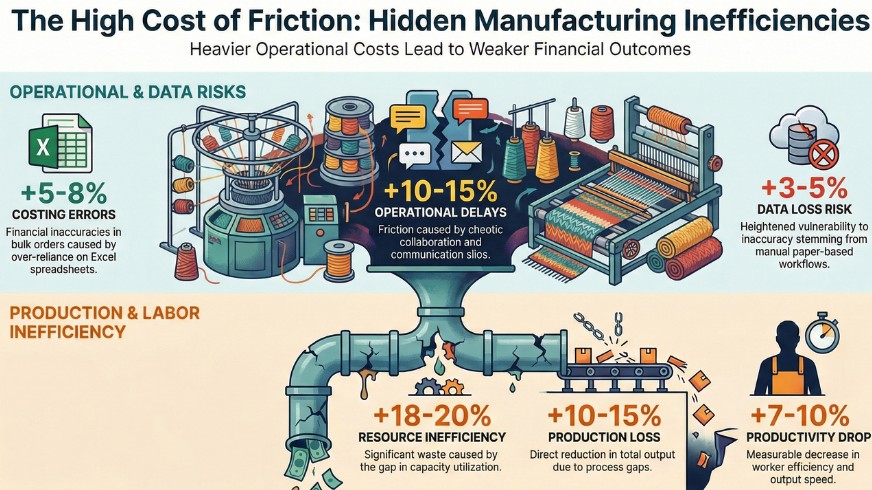
The figure tells us that without addressing these challenges, manufacturers will face high costs, which will eat away the profits, and ROI goals will be in question.
So, how to get rid of the challenges? The answer is simple: choose a digital solution (ERP) that can handle your processes, starting straight from yarn procurement to final order closure.
Through our conversation with knitwear manufacturers in Bangladesh, Nepal, and India, we have found that the manufacturers are eager to invest in ERP, but they often make one mistake — they choose generic ERP or local ERP that offers the basic ERP function but doesn’t really cater to the specific needs of a sweater manufacturing factory.
Thus, business owners who really want to scale up need a robust and tailored ERP for knitwear manufacturing, which is worth every penny they invest in.
And for that, KnitOne is the best option. Why? Let’s find out in the next section.
Why KnitOne is The Apposite ERP for Knitwear Manufacturing Industry
KnitOne is an ERP built specifically for knitwear manufacturing. To build the system, valuable constant input and feedback from industry experts were utilized.
KnitOne has custom modules that specifically address the unique needs of the flat-knit factory. From yarn to sales, business owners can record, track, and optimize every operational touchpoint.
With KnitOne, you get one unified way to work smarter.
Final Thoughts
The story of knitwear is a remarkable journey of human intelligence—from the rhythmic clicking of ancient bone needles to the high-speed hum of 2026’s fully automated hubs. Yet, in many modern factories, an invisible “static” remains.
Knitwear manufacturers may have the world’s most advanced 3D knitting machines, but they are still struggling for success. It’s due to the fact that the production flow is still tethered to manual spreadsheets and guesswork.
The pain of missed delivery deadlines, yarn wastage, and “firefighting” doesn’t arise from the employees; it arises as a result of a disconnected and fragmented system.
To truly scale, a knitwear factory needs more than just faster needles; it needs a unified digital heartbeat that syncs every stitch with the bottom line. This is where the narrative shifts from survival to dominance with KnitOne ERP.
KnitOne ensures that the process, beginning from the yarn cone to the final garment, is recorded, tracked, and used to take informed data-driven decisions.
Why wait? Boost Profits with KnitOne’s Complete Operational Visibility.
