


In the world of knitwear, every department is like a single panel of a luxury garment—beautifully crafted on its own, but completely useless until they are sewn together.
When these “panels” fail to align, the result isn’t just a loose thread; it’s an unraveling of the entire business. It further leads to delays, wasted resources, and miscommunication that reduces productivity by 25%.
But how does this chaos manifest in daily operations? What can be the best way to transform from chaos to clarity?
In this blog, we will take a deep dive into these collaboration issues and explore the optimum solutions to fix them.
Let’s start by understanding the truths of chaotic collaboration in sweater manufacturing.
4 Traits of Chaotic Collaboration in Knitwear Manufacturing
We have covered 4 obvious attributes of shambolic collaboration in knitting factories. Let’s get into the details.
1. Blurred Operational Visibility
Operational visibility is compromised when departments in a knitwear factory lack access to real-time, synchronized data.
For instance, when a merchandiser receives an urgent client request for an update, they must manually chase information from the production floor. With no real-time data, this could take anywhere from 30 minutes to over an hour. During this time, valuable time is lost, and the client is left waiting, causing frustration on both sides.
Similarly, with traditional inventory systems, production planning often relies on outdated data. This can lead to:
- understocking, causing delays as production waits for materials
- overstocking, where unused materials sit idle in the warehouse.
Without a centralized view, departments are misaligned, leading to wasted time, delays, and inefficiencies across the entire factory.
2. Disruptive Approval Bottleneck
Just like any organization, a knitwear factory also has its own way of systematic operations. However, the traditional workflow creates more unwanted buffer time.
Let’s look into the general workflow of the factory.
Merchandisers prepare the costing for orders, but senior staff must approve it before proceeding. Without digital tracking or reminders, approvals are often delayed. The longer the wait in merchandising, the longer procurement and production are held up, causing machines and workers to sit idle.
Without digital transformation in knitwear manufacturing, factories continue operating the traditional way, leaving room for process gaps and a lack of employee accountability—ultimately disrupting collaboration and slowing down the entire operation.
3. Spreadsheets are Everywhere
In a knitwear factory, spreadsheets are heavily used. Sadly, these sheets are scattered across departments—sales, inventory, and production. Although Excel is useful, it is not as powerful as a knitwear ERP. Moreover, overreliance on Excel leads to data duplication and misalignment.
For production, this lack of synchronization is a constant headache. Production plans are based on figures that are outdated by the time they are used. This leads to misaligned priorities, delayed work, and ultimately, a waste of valuable resources
Thus, when data lives in scattered sheets, collaboration turns into coordination chaos. Decisions slow down, supply chain forecasting becomes guesswork, and the factory spends more time correcting than producing.
4. Siloed Communication
A knitwear manufacturing factory operates with a sequential flow, where each department’s output directly influences the next.
The interconnectedness of departments might give the impression that siloed communication wouldn’t be a problem. But in reality, it can still occur because of a lack of a unified system and reliance on manual processes like paper logs, Excel sheets, and verbal handoffs.
The result? Teams operate based on fragmented, outdated information, making it impossible to collaborate efficiently.
With all these points, we can see the best fix– Implementing a digital solution like an ERP. However, generic ERPs should not be your first choice as they don’t quite cater to the needs and intricacies of the knitting factory. This is why you, as a knitwear business owner, need KnitOne-tailored ERP for knitwear manufacturing.
How KnitOne Brings Structured Collaboration to Your Factory?
KnitOne, built by the knitwear production experts, can address these issues and curb all the discrepancies caused by the manual processes.
It can give you clarity by curing chaos.
How? Here is a visual depiction of factory collaboration before and after KnitOne.
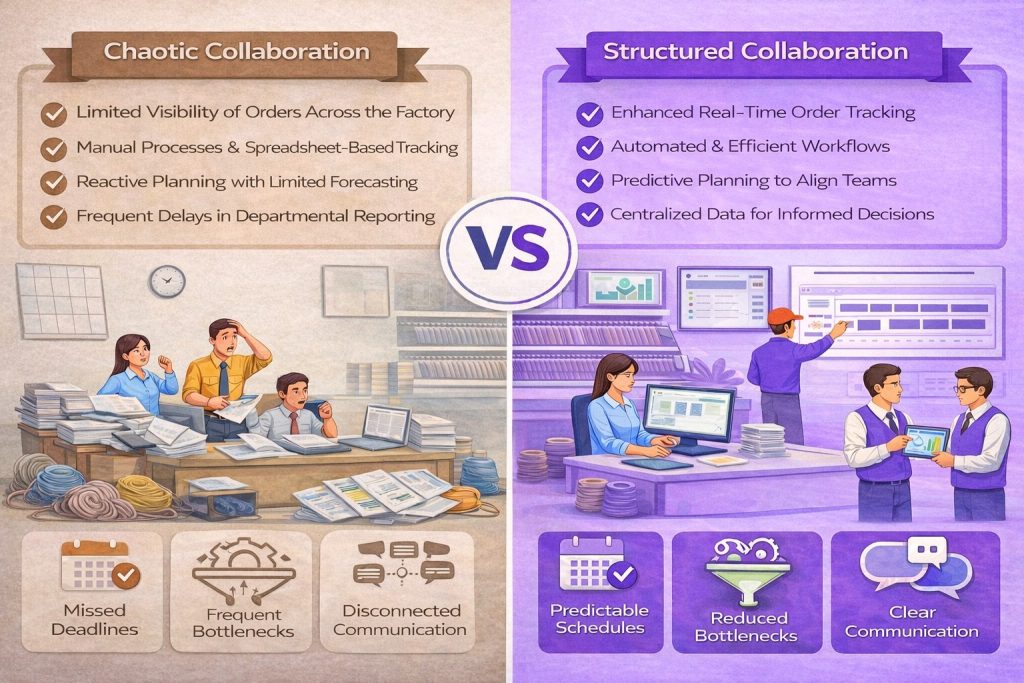
You can clearly see that KnitOne brings:
- Enhanced visibility into operations across all teams and stages.
- Automated workflows that minimize manual tasks and delays.
- Adaptive planning that helps teams align and stay ahead of potential issues.
- Centralized data integration to end silos
After getting a brief idea of how KnitOne fosters stronger collaboration, it is time to navigate the benefits it can bring.
5 Measurable Benefits of KnitOne-fostered Inter-departmental Collaboration
Here, we will look into some of the key advantages of structured collaboration brought by KnitOne.
I. Reduced Yarn Overbuying
By syncing procurement with real-time yarn inventory checks, KnitOne can help reduce yarn overbuying by 7-10%. This can minimize yarn wastage due to excess stock, lower storage costs, and ensure better cost control.
II. Fewer Departmental Disputes
With all teams working off the same real-time data, KnitOne can reduce departmental disputes by 35%, improving communication between sales, production, and inventory.
III. Improved On-Time Deliveries
KnitOne can improve on-time deliveries by 20% by providing clear visibility into production schedules and material availability. This could help teams align with real-time updates, enabling faster and more reliable buyer communication.
IV. Increased Employee Productivity
With automated workflows and the worker efficiency module, KnitOne can reduce manual follow-ups and administrative tasks by 40%. This allows employees to focus more on core tasks, which could significantly boost overall efficiency.
V. Better Production Planning
The Production Planning and Control module helps the production managers plan the optimum time for each step in the production cycle. By utilizing this very module, factories save up to 15% in operational costs and improve production scheduling.
Final Thoughts
Collaboration is the cornerstone of efficient knitwear production, but it can be difficult to achieve when departments are using manual systems or scattered spreadsheets. These traditional methods can lead to miscommunication, delays, and inefficiencies.
KnitOne is not just another generic ERP—it is a purpose-built solution for flat knitwear manufacturing that revolutionizes collaboration.
By centralizing data and streamlining communication across sales, production, and management teams, KnitOne ensures that every department operates with the same real-time information.
With features like automated workflows and demand forecasting, KnitOne fosters seamless collaboration, enabling faster, more informed decision-making across the entire factory.
Why wait? Boost Profits with KnitOne’s Complete Operational Visibility.
