


As knitwear businesses scale, problems rarely start with a lack of orders. They start when future pressure is not visible early enough—pressure from yarn availability, machine load, vendor delays, or delivery commitments piling up at the same time.
Industry studies show that supply chain disruptions can cost companies 6–10% of annual revenue (International Logistics Group), which highlights how risky reactive decision-making becomes at scale.
Supply chain forecasting exists to reduce this risk. Not by predicting the future perfectly, but by making upcoming constraints visible early enough for owners to act.
This blog looks at supply chain forecasting from a knitwear manufacturing perspective and explains how KnitOne supports it.
First, let’s understand the basics of this concept.
What Is Supply Chain Forecasting in Knitwear Manufacturing?
In knitwear manufacturing, supply chain forecasting is the process of anticipating where pressure will build next and preparing the factory accordingly.
It involves aligning expected demand with yarn readiness, machine capacity, production timelines, and vendor reliability—before those elements collide on the shop floor.
For owners, forecasting is less about numbers and more about decision confidence.
All in all, forecasting helps answer questions like:
Can we take this order?
Will yarn arrive on time?
Which weeks will be tight?
In knitwear manufacturing, supply chain forecasting is no longer optional—it is a prerequisite for controlled, sustainable growth.
Sadly, only a handful of knitwear factory owners are adopting digital transformation solutions. This hints that the persistence of traditional work processes, including supply chain forecasting. This kind of forecasting is doing more than damage. Let’s understand why.
Why Traditional Supply Chain Forecasting Is Hurting Growth
In the knitwear industry, any relevant forecasting is still done using spreadsheets. Statistically, 67.4% of supply chain professionals use Excel, and this rises to nearly 75% among experienced managers (electroiq). This is not due to ignorance or poor practice, but due to the less operational experience and trust in new tools and solutions.
In traditional forecasting, data—orders, inventory, capacity, production timelines—is spread across multiple files and departments. Each file may be accurate, but they are rarely updated together. When machines slow down, priorities shift, or vendors delay, these changes take time to reflect across all plans.
As order volumes grow, this disconnect slows decisions and forces owners into firefighting. Growth becomes constrained not because data is missing, but because traditional tools cannot keep planning and execution aligned as complexity increases.
This is where an ERP becomes necessary, not to replace human judgment, but to support it with structure and continuity.
Well, numerous generic ERPs are available to choose from, but KnitOne—a tailored ERP for knitwear manufacturing— has all the features and solutions that directly address the unique needs of knitwear production.
Let’s dive into how knitOne can help businesses forecast in the supply chain.
How KnitOne Enables End-to-End Supply Chain Forecasting
In knitwear manufacturing, forecasting only works when decisions across sales, materials, production, and vendors are connected. Planning one area in isolation simply shifts pressure elsewhere. KnitOne enables forecasting by connecting these areas into a single operational flow.
Having said that, let’s now get into how KnitOne directly caters to efficient supply chain forecasting in knitwear manufacturing.
1. Structured Demand Capture
Forecasting starts with how demand enters the system. In KnitOne, buyer inquiries and confirmed orders—both sample and bulk—are captured through a structured Order Management process.
Each order is linked with style-level technical data through Style Management, including yarn type, codes, category, and tech-pack consumption.
Because demand, style, and client information are connected from the beginning, forecasting is based on consistent inputs.
With KnitOne, buyer details, seasons, delivery dates, and special instructions are standardized at the point of entry. This gives owners and sales teams clearer visibility into what the factory is actually preparing for, reducing overcommitment and late-stage surprises.
2. Clearer Inventory Visibility
Once demand is clear, the next question is material readiness. In knitwear manufacturing, yarn is usually purchased only after orders are confirmed, but forecasting helps determine how much of that demand can be supported using existing stock.
KnitOne calculates yarn requirements by style and size, supporting both forecasting and merchandisers’ costing work. At the same time, available yarn—including carry-over inventory—is evaluated through Yarn Inventory. This allows owners to see how much demand can be covered internally and where future shortages may arise.
Instead of reacting to last-minute shortages, teams can plan procurement timelines with intent.
3. Capacity-Aware Forecasting
Capacity planning often fails because the future workload is unclear. Orders arrive in phases, styles vary by gauge and complexity, machines perform unevenly, and downtime is unpredictable. Many factories plan capacity based on ideal assumptions rather than realistic production behavior.
KnitOne strengthens forecasting by using data from completed orders, planned versus actual production timelines, and machine-level performance indicators such as utilization and downtime. This allows owners to recognize patterns from similar past orders and assess whether standard timelines still hold.
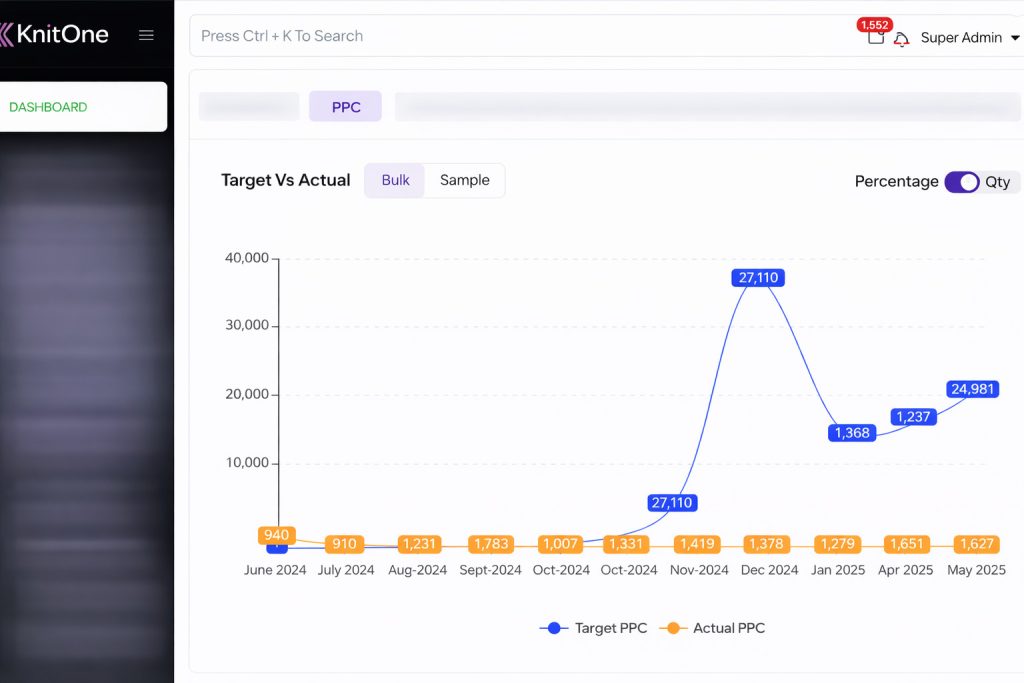
Instead of guessing how much the factory can handle, capacity forecasts reflect how the factory actually performs.
For further information, don’t forget to check out our Production Planning and Control.
4. Efficient Vendor Management
In knitwear manufacturing, forecasting is incomplete without vendors. Yarn delays, shade approvals, MOQ constraints, or last-minute substitutions can disrupt even the best internal plans. Vendor reliability is not external to forecasting—it is part of it.
KnitOne links forecasted demand and production plans with vendor-related constraints. By associating approved suppliers and expected lead times with predicted orders, factories can assess whether upcoming demand is realistically supportable.
This early visibility allows owners to engage vendors sooner, adjust schedules, or plan alternatives—before delays hit production.
5. One Forecast, Shared Across Departments
As factories grow, the challenge moves beyond data; it is more about understanding what deserves attention first.
KnitOne’s Dashboards and Reports consolidate forecasting signals into a single forward-looking view. This shared visibility enables collaboration among sales, production, procurement, and management, ensuring everyone works from the same forecast rather than separate assumptions.
Rather than reviewing static summaries, owners can see where pressure is building—overloaded weeks, material gaps, or delivery risk—while there is still time to act.
| Important Point To Consider Instead of predicting future demand just by looking at what happened before (like past sales numbers), using the real reasons behind demand, like economic trends or promotions, can boost supply chain forecasting accuracy by 10-20%. Such accuracy means the ability to cut excess inventory costs by about 5% (less wasted stock) and boost revenue by 2-3% (McKinsey). |
Final Thoughts
In knitwear manufacturing, growth fails not because orders stop coming—but because future pressure becomes invisible until it is too late.
When demand, materials, capacity, and vendors are planned separately, scaling only amplifies risk. In such a situation, end-to-end supply chain forecasting gives owners foresight.
By connecting demand capture, inventory readiness, capacity realism, vendor dependency, and execution feedback, KnitOne helps make future constraints visible early.
This allows knitwear businesses to grow with control, protect margins, and deliver consistently—without relying on constant firefighting.
So, Why Wait? Boost Profits with KnitOne’s Complete Operational Visibility.
