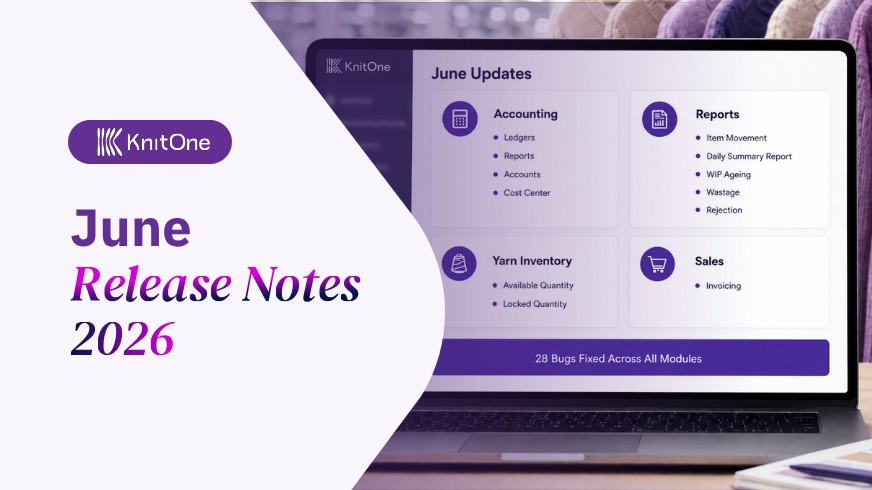

In June, team KnitOne focused on making factory information more traceable, structured, and decision-ready.
With 50 major tasks completed, this release brings meaningful improvements across various modules of KnitOne: reports and dashboards, yarn inventory, accounting, sales, and warehouse.
Let’s look into these major June updates that made KnitOne Intelligence more practical, transparent, and reliable for daily sweater factory operations.
What Are the Major Updates of June in KnitOne?
Below is a brief explanation of the most significant updates across different modules, along with their operational impacts.
1. Accounting, and Cost Center Improvements
The‘KnitOne Accounting Module’ has been improved, especially in integration and reporting aspects.
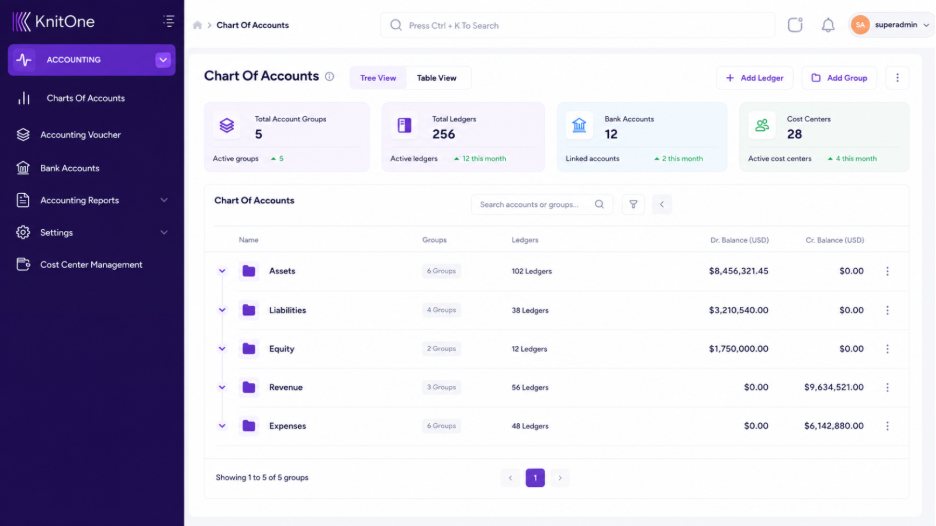
- Accounting integrations
The DayBook API and Bank & Reconciliation Management API were integrated to enable smoother accounting data transfer and support bank reconciliation functions.
Middleware was integrated between KnitOne, Cost Type Master, and PO Procurement Cost to ensure procurement cost data flows smoothly into accounting and cost management.
- Accounting Reports
New Debtors Ageing and Creditors Ageing reports were added to help accounting teams track receivables and payables more clearly. A new Cost Center Report was added under Accounting Reports.
Also, the Cost Center Management was improved with a new cost center field in accounting vouchers and added sidebar functionality.
Impacts:
- Supports smoother accounting data transfer inside KnitOne.
- Helps accounting teams manage bank reconciliation more systematically.
- Connects procurement cost data with accounting and cost management more effectively.
- Helps track customer receivables and supplier payables more clearly.
- Makes cost tracking more structured across factory operations.
- Supports cleaner voucher-level cost classification and easier cost center access.
2. Reports, Analytics, and Dashboard Visibility
Reporting remained one of the biggest focus areas in June. Several new reports were introduced to help with various aspects of sweater manufacturing.
In the next section, a list of new reports along with their use is mentioned:
The Item Movement Report
Item Movement Report was introduced to track the movement of different item types such as assets, consumables, general items, and services.
Daily Summary Report
- It now includes indicators for Target PPC and Actual PPC to spot the difference between these two.
- The PPC utilization view was also extended. Along with the existing 1-month, 2-month, and 3-month PPC utilization views, a new 4-month PPC utilization view was added.
WIP Ageing Report
This report was added to help teams identify where work-in-progress is staying for too long across production stages: knitting, linking, finishing, packing, and warehouse movement.
FG Ageing Report
FG ageing report was introduced to track the number of days any finished goods would stay in the warehouse after completing production.
Wastage Report
Wastage Report includes data on yarn consumption, knit wastage, panel return, wastage percentage, and rejection quantity of orders.
Defect, Rewind and Reject Report
This report was added to make quality-related tracking more structured. This gives teams better visibility into rejection, rework, rewind, and defect-related data.
Besides these new reports, existing reports have also improved. Below are the major updates:
- In the Yarn Return Reports– a part of Yarn stock reports- the client/buyer’s name is now visible.
- The Yarn Decommission Report now displays the approval date instead of the date the record was created. It also includes a new Transaction ID column.
- The Department Production Report was improved by adding columns for composition and count.
- The FG Movement Report was also improved with warehouse details and report period visibility at the top of the report.
- The Summary Dashboard was updated with red color once the days (pending days) exceed the standard period as per configuration.
- The Daily Report now includes separate Export and Domestic categories for a clearer view of factory performance by market type.
Impacts:
- Helps track the movement of assets, consumables, general items, and services.
- Makes it easier to compare planned PPC and actual PPC and understand production utilization trends.
- Helps identify WIP stuck across knitting, linking, finishing, packing, and warehouse movement.
- Shows how long finished goods remain in the warehouse after production completion.
- Gives clearer visibility into yarn consumption, knit wastage, panel return, wastage percentage, and rejection quantity.
- Helps quality teams review defect, rework, rewind, and rejection data more systematically.
- Improves traceability in Yarn Return, Yarn Decommission, Department Production, FG Movement, Summary Dashboard, and Daily Reports.
3. Robust Yarn Inventory for Rightful Use
Yarn control was improved with better visibility into locked quantity, usable quantity, inventory quantity, and transaction-level tracking.
- A new “Usable Qty” column was added to ‘yarn inventory management’ to show the quantity of yarn available for production.
- The client/buyer’s name was added to the “Receive Yarn” HAB and the “View Details” page for General Yarn Indents.
- The Yarn BoQ section now includes Active Lock Qty and Last Lock Qty columns.
Impacts:
- Makes yarn allocation and lock status easier to understand.
- Helps connect yarn receipts with the right client or buyer.
- Reduces confusion while checking yarn availability for production planning.
- Makes Yarn PO documents clearer and more consistent.
- Makes high-balance yarn stock easier to review first.
4. Sales Invoice and Sales Order Updates
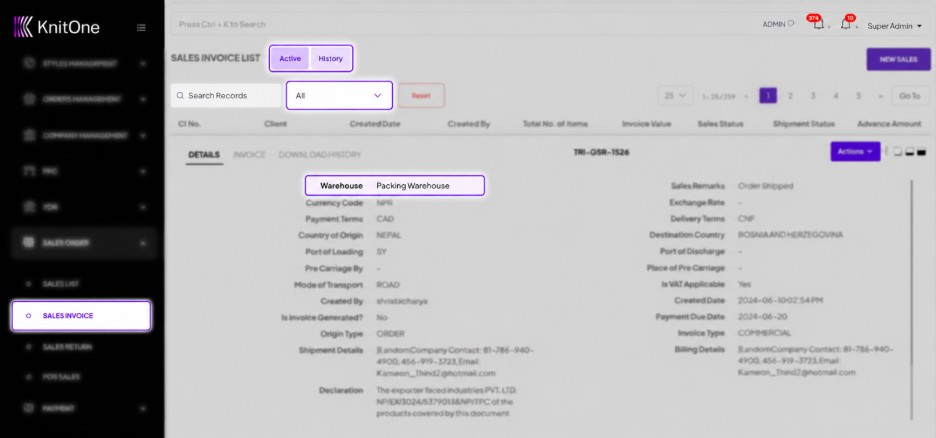
Some key features in the sales module were improved to make invoice tracking and warehouse-level sales visibility clearer. These features are as follows:
- Currency visibility was added in the Invoice Value and Advance Amount columns in both Active and History tabs.
- The Sales List and Sales Invoice History tabs now include an Invoice ID column.
- In the Warehouse filter of Sales Invoice, A new ‘All’ option was added. Likewise, the ‘warehouse name’ is now made visible in its HAB for both Active and History tabs.
Impacts:
- Makes invoice amounts easier to read and verify.
- Improves invoice tracking and historical record review.
- Helps in reviewing sales invoice records across warehouses.
- Makes warehouse-level invoice details clearer.
- Reduces confusion while checking Active and History sales invoice records.
Other Important Updates
Apart from the major module updates, several smaller improvements were also completed in June:
- The usable quantity calculation in Yarn BoQ was improved to align with the Lock Yarn BoQ Details logic.
- A new Transaction ID column was added to the Yarn Stock Issue Datewise Report for better yarn transaction traceability.
- Yarn PO PDF downloads were improved with currency code and quantity precision.
- Nepali Calendar integration was completed in the Financial Module.
- Color code visibility was enabled in the GSR for packaging orders.
- The Weekly Yarn Stock Summary Report was arranged from the highest to lowest balance quantity for easier review.
- The Item Consumption Datewise Report now includes the Consumed Department for item and asset issue transactions.
- Sorting logic was improved in Yarn Stock and Manage Yarn PO reports.
- Location tracker updates were completed for better tracking accuracy.
- Unnecessary fields and report deliveries were removed to keep the system cleaner.
Bug Fixes & Improvements
Team KnitOne resolved 28 bugs across the June releases to improve system stability, reporting accuracy, and user experience.
Some of the major bugs fixed are highlighted below:
- Corrections across Production Order Status, Panel Transfer source and destination filters, FG Warehouse filter, and Dashboard Order Status by Gauge were done.
- Sales Invoice issues related to invoice type changes, missing Invoice ID, incorrect validation messages, and table size were fixed.
- Yarn issue and YDR approval errors were resolved.
- Yarn Decommission Report issues related to total values, branch filters, null validation, and downloaded Excel data were corrected.
- Rewind and Reject Report were improved to reflect rework data properly.
- Costing issues related to FOB conversion rate and Total Qty KG calculation were resolved.
- Warehouse QR Print label was corrected from Select Colorway to Select Colors.
- Tech pack JPEG upload issues were resolved in Manage Styles.
- Packaging Order QR scanning and Add to Carton/Transfer issues were fixed.
With a new robust accounting module, stronger reporting, improved yarn control, streamlined warehouse management, and more accurate sales invoicing, KnitOne aims to make sweater manufacturing operations more transparent, traceable, and data driven.
All in all, KnitOne continues to evolve as a purpose-built ERP for sweater manufacturers who need complete operational clarity from yarn to finished goods.