
A sweater factory does not lose control all at once. It happens gradually through missed updates, weak planning, delayed material visibility, and disconnected execution between departments.
What looks like a delivery delay is often a deeper systems issue rather than logistics. And the real issue is running knitwear manufacturing on scattered and disconnected systems. That is why ERP (enterprise resource planning) has become more relevant in sweater manufacturing.
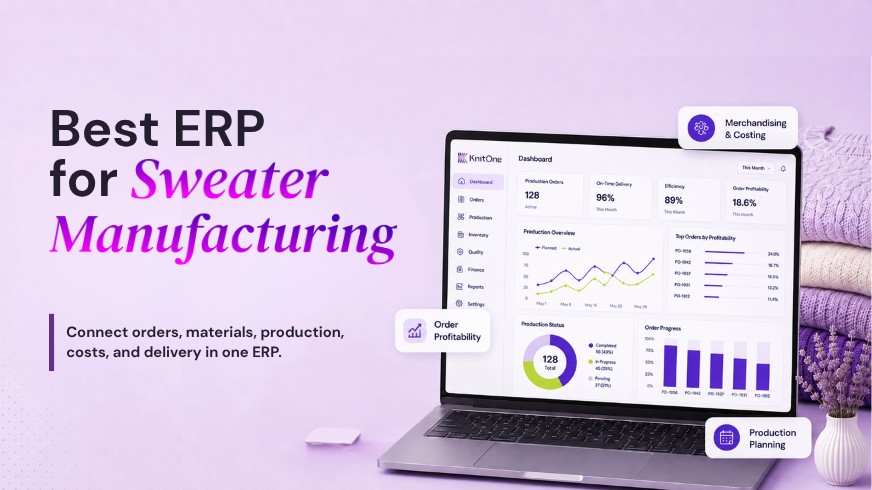
A purpose-built knitwear ERP helps factories connect the operational details from merchandising to production planning, execution, reporting, and shipment.
This guide covers what a knitwear ERP actually does, how it differs from a generic ERP system or a broader textile ERP, which modules matter most, and how to evaluate solutions for knitwear manufacturers before you commit to one.
Key Highlights
- Sweater manufacturing is a crucial industry contributing to the global economy.
- Although potential, many manufacturers are still using traditional and manual systems to run their factories.
- With ERP software, sweater factories can earn complete operational visibility and efficiency.
- Generic ERPs need heavy customization, which is costly and time-consuming for the knitwear industry.
- Industry-specific ERP doesn’t need heavy customization, aids in standardizing workflows, and improves operational efficiency.
- A knitwear ERP helps factories manage inventory, costing, production planning, order execution, and reporting through one connected system.
- KnitOne is the best ERP for sweater factories, built on real industry expertise with features tailored for complete knitwear operations.
- KnitOne helps connect and streamline knitwear operations, helping reduce yarn wastage and increase profits.
What is ERP for Sweater Manufacturers?
ERP for sweater manufacturers is a specialized software system designed to connect and manage the core operations of a sweater factory through a single platform.
Who requires ERP for knitwear manufacturing?
- Factories with multiple branches that require better resource planning, coordination, operational control, and productivity
- Growing manufacturers who are struggling with manual processes and spreadsheets
- Export-oriented factories which are managing strict delivery commitments and buyer expectations
When should a sweater manufacturer switch to ERP?
- When manual tracking becomes difficult to manage
- When departments operate with separate or inconsistent information
- When order delivery is constantly missed; heavy penalties for each order
- When management lacks real-time visibility into operations
- When order volume and factory complexity continue to grow
- When existing systems limit efficiency and future expansion
- When production managers lack real-time visibility into floor status
How Does ERP Work in a Sweater Factory?
- Tracks and updates yarn, accessories, raw materials, and finished goods to keep stock information accurate.
- Calculates material and production costs to help maintain accurate costing and profitability.
- Helps create production plans and monitor progress throughout the manufacturing process.
- Tracks order status and delivery timelines to ensure timely completion.
- Turns factory data into reports and dashboards to identify trends, issues, and areas for improvement.
Now, let’s look into what exactly the ERP for the sweater industry actually has to offer.
Key Features of ERP for Sweater Manufacturing
A sweater ERP does more than record; it tracks the entire knitwear production operations and reflects them in the form of reports and analytics. And how does it do so? With the help of features/solutions catered to specific departments.
Let’s get into the details of the knitwear ERP features.
1. Dedicated Inventory Management
Inventory Management helps garment manufacturers efficiently track and control inventory of raw materials across the supply chain. It provides stock visibility, ensuring accurate records, and smooth production operations.
Inventory module of a sweater ERP includes:
- Item, Batch/Lot, and Serial Number Tracking
- Real-Time Stock Visibility
- Automated Stock Receipt, Transfer, and Adjustments
- Manufacturing and Expiry Date Tracking
Improves inventory accuracy, reduces errors, streamlines stock operations, and supports better purchasing and production decisions.
2. Costing and Sales Management
Merchandising and Costing are at the core of knitwear manufacturing. Merchandisers prepare order costing, communicate with buyers and suppliers, and collaborate with almost all departments in the factory.
With a sweater ERP, merchandisers can make material requirement planning (MRP) calculate exactly how much yarn, trim, and accessory stock an order needs before production starts, tying directly into a bill of materials for each style.
Further, it helps manage orders, vendors, and buyers while also quoting profitable costing, coordinating activities across departments, and ensuring delivery on time.
Key functions of knitwear ERP for merchandisers include:
- Style and Order Management
- Vendor Management
- Customer Relationship and Document Management
- Order Costing
- Sample Development and Approval Tracking
- Material Booking and Reservation
- Design and Embroidery Follow-Up
- Shipment Planning and Tracking
- Margin and Profitability Monitoring
It helps merchandisers manage orders, costs, and follow-ups from one place. Further, it helps in improving coordination and collaboration within all departments of the factory. This helps in reducing delays, keeps everyone updated, and ensures orders are completed on time and within budget.
3. Production Planning and Tracking
Production Planning is a critical function in sweater manufacturing to stay ready for order execution and complete orders on time, and within available resources.
It involves planning, coordinating, and monitoring every stage of production—from order receipt and material preparation to knitting, dyeing, finishing, packing, and dispatching.
Production planning includes the following:
- TNA configuration tied to the production schedule
- Machine capacity planning
- Production manpower planning
- Process routing across knitting, linking, dyeing, and finishing
- Progress tracking against the production process
- Delivery Schedule Management
Production planning helps in improving production visibility for both sample and bulk orders. Since it is a plan, it helps the factory stay prepared and act accordingly to have on-time order delivery without paying a penalty.
4. Quality Control and Job Tracking
Producing knitwear with the highest quality is necessary to avoid buyers’ rejection and gain buyers’ trust. Quality Control (QC) focuses on product quality. It involves inspections, lab dip approvals, sample tracking, rejection management, and rework logging.
Whereas Job Tracking focuses on production traceability. It monitors where a batch is, what stage it has completed, who handled it, and when it moved through the process.
In fact, job tracking provides the traceability needed for effective Quality Control
5. Production Management
Production management helps in running, monitoring, and controlling manufacturing activities throughout the production cycle.
This feature provides complete visibility into production progress across knitting, dyeing, linking, washing, finishing, and packing processes.
Production management covers the following:
- Stage-wise production tracking
- Work-in-progress (WIP) monitoring
- Capacity and resources management
6. Warehouse Management
Warehouse management helps in storing and tracking Finished Goods (FG).
It covers the following:
- Real-time stock visibility across locations
- Multi-warehouse and multi-branch transfer tracking
- FG dispatch readiness
This feature helps maintain FG accuracy and minimize discrepancies.
7. Delivery Management
Delivery management helps in planning, tracking, and controlling the shipment process from finished goods to final delivery.
This feature provides complete visibility into packing, dispatch, shipment status, and delivery schedules.
Delivery management covers the following:
- Shipment management
- Buyer-specific packing management
- Delivery schedule monitoring
- Logistics coordination
- Delivery reporting
8. Reports, Analytics, and Insights
A robust ERP solution for knitwear manufacturing captures real-time data of each department in the sweater factory. The following are the reports that manufacturers can get with a knitwear ERP:
- Merchandising and Buyer Reports
- Yarn Consumption Reports
- Machine Utilization Reports
- Resource and Capacity Planning Reports
- Production Performance Reports
- Rejection, Reworks, and Wastage Reports
- Purchase and Supplier Reports
- Warehouse Management Reports
- Sales and Revenue Reports
- Costing and Profitability Analysis
With reports visualized in the dashboard, manufacturers identify trends, patterns, performance gaps, bottlenecks, operational inefficiencies, risks, and opportunities. Further, they can make data-driven decisions to improve productivity and increase profits.
Well, these were the features of a sweater ERP, but why would manufacturers need an ERP when the factory is running ‘smooth’? Details are provided below.
Why Sweater Manufacturers Need a Specialized ERP?
Sweater manufacturers need a specialized ERP to address the complexities of knitwear manufacturing operations, make an effective digital transformation, and avoid all sorts of confusion and costs connected with generic ERPs.
Below, we have explained why knitwear manufacturing factories should invest in specialized ERP.
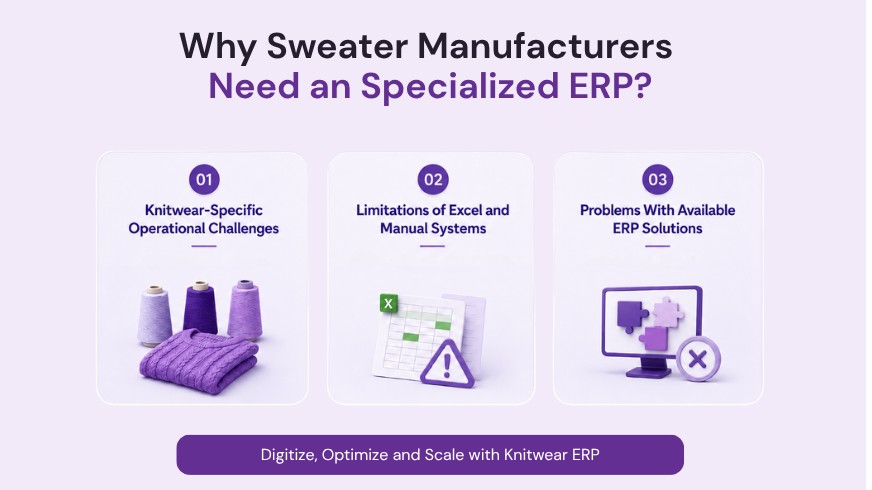
1. Knitwear-Specific Operational Challenges
Sweater manufacturing is more complex than many other production environments. It depends heavily on material quality, machine suitability, panel movement, process sequencing, and stage-wise coordination.
Even a small issue in yarn lot control, planning, rejection, or handover between departments can affect cost, quality, and delivery.
At the same time, manufacturers are under growing pressure to run more sustainably, which means reducing wastage and unnecessary cost while still protecting profit.
Thus, sweater manufacturers need a knitwear-specific ERP to handle the intricate details and ensure sustainability.
2. Limitations of Excel and Manual Systems
Many sweater factories still rely on registers, Excel sheets, calls, chat groups, and separate departmental trackers to record and follow operations.
These manual tools may seem manageable at first; they become difficult to control in knitwear manufacturing, where clear visibility is essential to identify issues early and respond on time.
As knitwear operations grow, such systems also increase dependence on individuals and often lead to delayed, fragmented, or inconsistent updates. That is why digital transformation in knitwear manufacturing is no longer optional.
For factories that want stronger control, faster visibility, and better coordination across departments, ERP has become the most practical and effective solution.
3. Problems With Available ERP Solutions
Many ERP solutions in the market are generic ERP systems built for broad functions like inventory, administration, finance, and reporting. But when knitwear factories adopt them, heavy customization is often needed to make them work for actual factory operations, which means more time, cost, and internal effort.
While textile, garment, and apparel ERPs are also available, they aren’t the best solution because:
- ERP for textile or textile ERP platforms are built around fabric and weaving-based textile manufacturing, textile production, and broader textiles and apparel supply chains.
- Apparel ERP or general garment manufacturers’ systems are usually cut-and-sew (fabric-based) rather than yarn-based.
To add more, knitwear production styles are different- flat-knit and circular knit. Flat-knit requires panel-by-panel shaping, while circular-knit facilities must bridge yarn-knitting with final assembly.
Thus, the best option for knitting manufacturers is to select an off-the-shelf ERP with native logic, and workflows to avoid expensive customization.
Well, we discussed the need, which is more like why the industry must switch to ERP for the sweater industry. But what exact advantages can be garnered with such software? We have covered that in the next section.
Benefits of Industry-specific ERP in Knitwear Industry
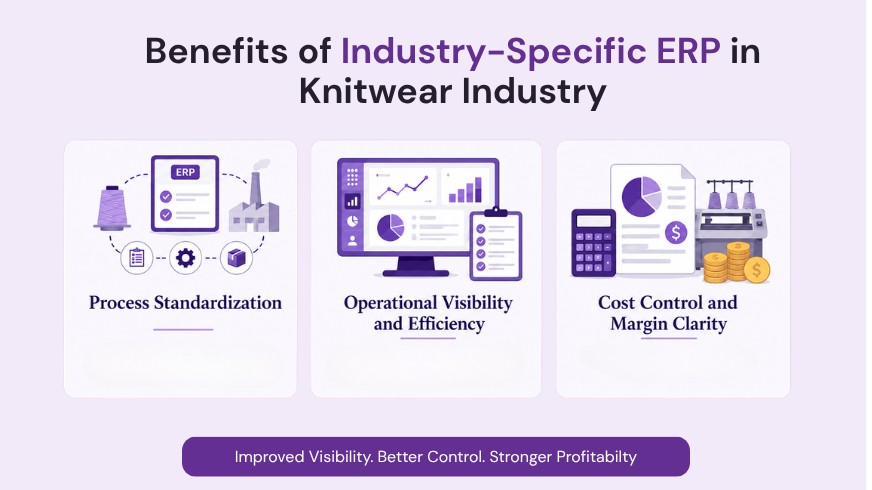
Knitwear ERP offers several practical benefits to sweater factories, especially in the areas of process standardization, operational visibility, efficiency, and cost control. Let’s look at these more closely.
1. Process Standardization
ERP helps sweater factories standardize processes by bringing departments and operations into one connected system.
In knitwear manufacturing, this allows functions such as inventory, merchandising, production planning, panel processing, shipment, and finance to follow clearer and more consistent workflows.
With better workflow visibility and shared data across departments, ERP reduces operational inconsistencies and improves coordination. As a result, factories can work with stronger discipline, fewer process gaps, and better day-to-day efficiency.
Fun fact: 58.4% of organizations reported achieving the level of process standardization they expected following ERP implementation (Panorama Consulting Group).
2. Operational Visibility and Efficiency
A knitwear ERP gives factories clearer visibility into what is happening across key departments such as merchandising, production, warehouse, and delivery.
This visibility helps managers and owners identify gaps, bottlenecks, and delays earlier, making it easier to take the right action at the right time. Over time, department-wise reports also support more informed decision-making.
With better visibility and timely intervention, communication improves, workflows become more aligned, and overall operational efficiency becomes stronger.
3. Cost Control and Margin Visibility
Although ERP implementation requires upfront investment, it can play a major role in improving cost control over time.
Knitwear ERP tracks:
- Yarn usage and waste cost
- Production cost
- Overhead cost
Interestingly, with the right strategy, ERP can also aid in tracking hidden costs of inefficiency within knitwear manufacturing.
With detailed reports and analytics, factories can compare estimated order costs with actual costs and spots where leakages occur. This gives management clearer margin visibility and helps improve future costing and production strategies.
Read More: What are the Important Reports for Sweater Manufacturers?
Choosing the Right ERP for Knitwear Manufacturing
Well, these are the obvious benefits manufacturers can relish with sweater industry ERP. With an ample number of options available, it becomes hard to pick THE one for your factory. For that, you should evaluate all garment ERPs based on certain features explained in the next section.
Key Criteria to Evaluate the Best ERP for Knitwear Manufacturing
Let’s understand the major decision-making factors to find the most suitable ERP for knitwear manufacturing.
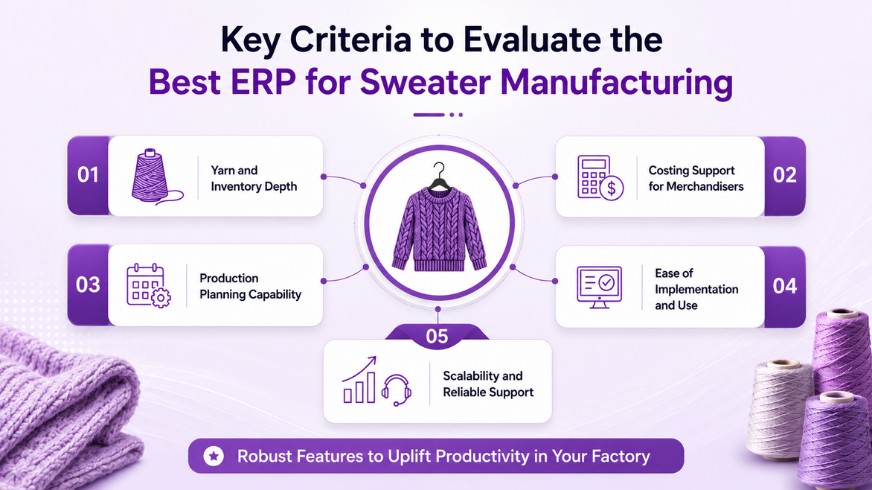
1. Ability to capture yarn and inventory details
Sweater ERP is always more than just inventory management. But it doesn’t mean that it gives no emphasis on inventory. Rather, such an ERP must be smart enough to capture details of yarn and inventory granularity.
2. Easing the costing processes for merchandisers
Another important feature to look for is how well the knitwear ERP helps the merchandisers, especially in costing and communication.
With aid in costing, merchandisers can quote beneficial costs, while with real-time data and status, they can convey order status without chasing or waiting for anyone.
3. Scope of effective production planning
Sweater production doesn’t start just after order confirmation; it needs proper production planning. Such planning includes:
- Preparation of TNA, which serves as a reference for dates to purchase materials, production (knitting, linking, and finishing) and delivery
- Estimate the number of machines and manpower needed.
4. Ease to implement and use
Any sweater ERP may have the best features, but when it gets complex to introduce in the factory, it results in costly ERP implementation failure. Thus, an ERP should be easy to implement.
Read our blog ‘What You Should Know About ERP Implementation’ for details on ERP implementation.
For an ERP to be effective, the end user has to understand it and use it effectively. Thus, a sweater ERP needs to provide ease when using it. Such ease can be measured via:
- UI/UX design: Simpler, Easy, Intuitive and User-friendly
- Learning curve: Needs to be steep enough to achieve rapid core competency, yet gradual enough to prevent user burnout
5. Scalability and reliable support
Factory owners implement an ERP to digitalize and grow their business. For that, ERP scalability is a must.
Thus, a knitwear ERP should be able to grow alongside the business. It must support increasing production volumes, users, and operational demands without compromising efficiency or performance.
Further, to achieve scalability, continuous, reliable technical support becomes indispensable.
Now, the burning question: ‘Even though there are numerous sweater ERPs available in the market, why choose KnitOne?’ We have covered the answer in the section below.
What makes KnitOne the best ERP for Sweater Manufacturing Factories?
KnitOne is a tailored ERP for sweater manufacturers developed by team AstraSoftech.
In the next section, details of why KnitOne is the best ERP for sweater manufacturing are discussed.
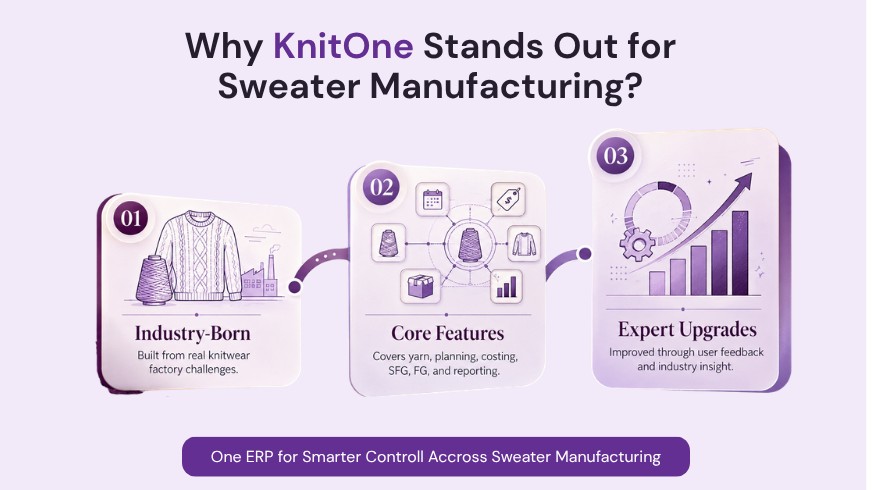
1. Concept Born from Real Knitwear Industry Experience
The idea behind KnitOne did not begin as just a software concept.
The concept of KnitOne as a knitwear ERP emerged from years of real knitwear industry experience, seeking one-stop solutions for constant operational gaps, coordination issues, and control challenges in the factory.
Such practical understanding was later shaped into a software solution built specifically for sweater manufacturing needs.
2. Built with the Core Features Sweater Factories Actually Need
KnitOne has the robust features referred as KnitOne Intelligence. This intelligence understands the intricacies and actual concerns of knitwear manufacturers and provides the optimum solution.
With KnitOne Intelligence, manufacturers can get:
- Effective Adaptive Production Planning
- Streamlined Merchandising, Costing, and Sales
- End-to-end Order Management
- Confusion-free SFG Tracking with QR/RFID
- Strong FG Storage and Management
Besides these features and ERP modules, other key technical aspects, such as user adoption, UI/UX, and learning curves, are better. All these features certainly make KnitOne more than inventory software among people.
3. Continuously Refined Through Expert Insight and Practical Upgrades
KnitOne continues to evolve through regular technical upgrades, which are usually featured in the release notes. Not just that, KnitOne also makes the functional upgrade via experts’ insights and user feedback.
Lately, KnitOne collaborated with Sweater Guru, Mr. Sunil Puri, to add features and build other new features to make KnitOne even stronger and more market-savvy.
To gauge KnitOne’s caliber in bringing real impact, you can go through our latest case studies.

Final Thoughts
The global knitwear market is estimated at USD 1122.91 billion in 2026 and is projected to reach USD 2794.22 billion by 2034 (Straits Research). This clearly shows the strong potential ahead for sweater manufacturers.
However, tapping that potential seems difficult as numerous sweater manufacturers still rely on registers, spreadsheets, calls, and departmental follow-ups to manage daily work. These methods may have supported factories for years, but as operations grow, they can make visibility weaker, updates slower, and coordination more difficult across departments. Thus, digital transformation via ERP has become a must.
There are numerous ERPs available, but among them, KnitOne is the most prominent. Unlike broader ERP options that often need heavy adjustment before fitting knitwear operations, KnitOne is built around the actual workflows of sweater factories.
With KnitOne, knitwear manufacturers can improve productivity, coordination, and profitability through better systems and stronger operational control.
Why wait? Boost profits with KnitOne’s complete operational visibility.
Frequently Asked Questions (FAQs)
What is ERP software for knitwear manufacturing?
ERP software for knitwear manufacturing is a specialized ERP solution that helps knitwear manufacturers manage inventory, production planning, costing, order tracking, quality control, and delivery on one platform.
Is ERP necessary for small knitwear factories?
Yes, ERP can be necessary for small knitwear factories if the factory wants better control over knitwear manufacturing operations, from knitting and dyeing to packing and delivery.
How does ERP help manage yarn inventory?
ERP helps sweater manufacturers manage yarn through:
- Lot-wise tracking
- Color-wise tracking
- Order-wise allocation
- Stock visibility
- Issue and consumption records
Can ERP improve costing accuracy in knitwear production?
Yes, an ERP can improve costing accuracy as it helps merchandisers make accurate order costing, connecting costs for sweater manufacturing production. Not just that, it can also help solve costing concerns of merchandisers.
How long does it take to implement a knitwear ERP?
ERP implementation depends on factory size, process complexity, data readiness, and user training.
Can ERP replace Excel for knitwear production management?
Yes, an ERP is capable of replacing Excel in production management in knitwear production. However, production managers can use Excel for relevant purposes.
Is cloud-based ERP suitable for knitwear manufacturers?
Yes, cloud ERP is suitable for knitwear manufacturers. But on-premises sweater ERP can also be a better deployment option for factories, as most of them are set up in remote areas.
Can ERP reduce production delays in knitwear factories?
Yes, ERP can reduce production delays in knitwear factories as it can help in improving production planning, raw material visibility, process routing, and order tracking.
Does ERP support yarn lot and color-wise tracking?
Yes, knitwear-specific ERP can support both yarn lot-wise and color-wise tracking.
What is the Role of Textile Printing in Knitwear Manufacturing?
Textile printing plays an important role in knitwear manufacturing by adding designs, logos, patterns, and branding elements to garments. It enhances the visual appeal of knitwear.
What is the difference between knitwear ERP and garment ERP?
Knitwear ERP is built for yarn-based factory operations, which are for knitted garments (flat or circular), while garment ERP can cater to fabric-based operations, which include knitted and weaving operations.
What is discrete manufacturing ERP and source ERP in knitwear manufacturing?
In knitwear manufacturing, discrete manufacturing ERP is the actual software used to run the factory, while Source ERP is just a label for the main database where your clothing data lives before it gets shared with other apps.
What are the challenges of ERP in sweater manufacturing?
The main challenges usually include:
- Data Migration
- Employee Resistance
- Leadership Commitment
- User Training
- System Integration
Which is the best ERP for sweater manufacturers in India?
There are numerous ERPs for sweater manufacturers in India, but the one that understands and adapts to Indian manufacturers’ needs is KnitOne.
Read our blog ‘Finding the Best ERP for Sweater Manufacturers in India’ for detailed information.