
India’s textile and apparel industry contributes around 2.3% to the nation’s GDP. Within the apparel industry, knitwear holds a major place, with Tirupur ruling the cotton knitwear and Ludhiana for woolen production.
Thanks to talent, techniques, and machines, the Indian knitwear industry is thriving. But managing that growth requires more than machines; it requires stronger control across operations.
Sadly, the required operational control, coordination, and collaboration are missing in the knitwear factories of India. And it’s not because the factory owners don’t care; rather, it’s because they don’t have a clear idea of what the optimum solution is.
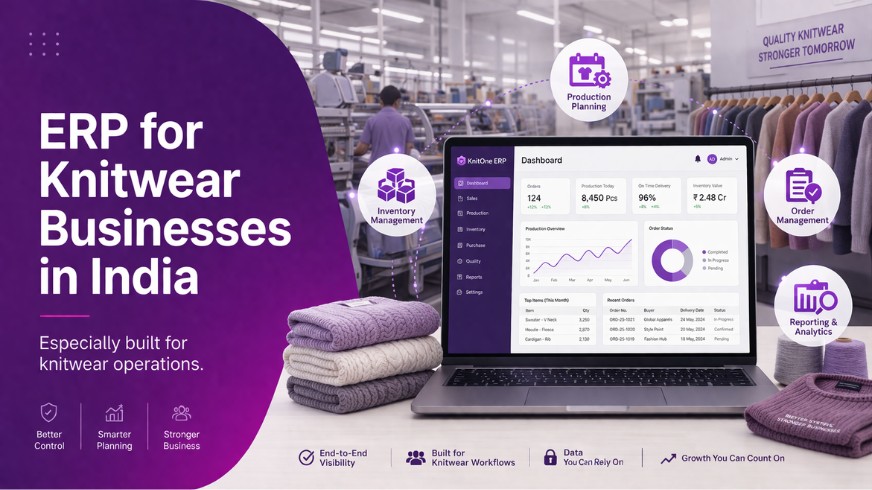
The only solution to fill the operational gaps and replace the current disconnected and fragmented systems is an ERP solution, especially the knitwear ERP.
In this blog, we will help you find the most suitable ERP for your knitwear industry.
But first, let’s start with why ERP is a must-have in 2026 for Indian sweater manufacturers.
Why Sweater Manufacturers in India Need ERP Software?
Sweater manufacturers in India need ERP software to compete with other major players in the industry, stay compliant with sustainability goals, and adopt digital transformation.
Let’s understand these internal high-impact reasons in detail.
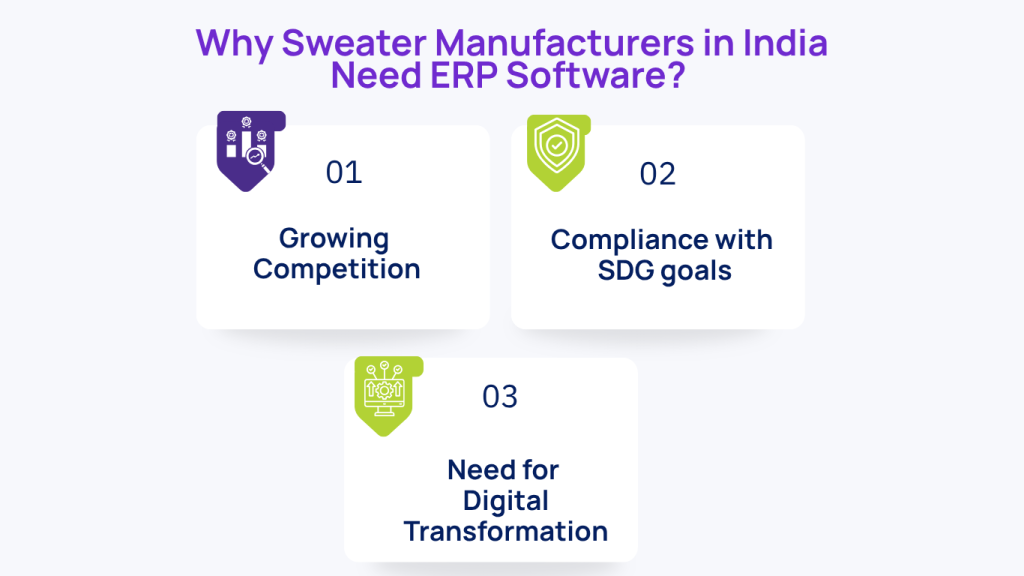
1. Growing Competition in the Indian Apparel Industry
Indian sweater manufacturers have been competing at the international and domestic levels.
For internationals, the top contenders are China, Bangladesh, and Vietnam. These are the key players in the global textiles and clothing trade.
At the domestic level, they are competing with established apparel and knitwear players such as Monte Carlo, Lux, Dollar, and Rupa. The internal competition among the manufacturers is predicted to get fiercer as the recently signed FTA between European Union and India (2026) is set to open massive export opportunities.
When the competition is to match up with these giants, factories can’t miss quality and faster delivery. And these are almost impossible to achieve with heavy reliance on spreadsheets, manual follow-ups, and disconnected records.
With an ERP, factories can keep track of the production quality and quantity. This eventually helps stay in competition; if not, then at least improve their production.
2. Stay Compliant with Sustainability Goals
For a knitwear factory, sustainability generally refers to less wastage production and recycling as much as possible.
Beyond the factory, sustainability has become a buyer’s expectation. Buyers from the US, Canada, and Europe look for manufacturers who have ethical sourcing, responsible material use, and align production with SDG 12 (responsible consumption and production). This makes material control and traceability more important than ever.
An ERP system can create digital traceability by logging yarn sourcing, issuance per order, and production movement. This reduces excess buying, provides audit-ready records for ethical sourcing, and supports SDG 12 through waste minimization and responsible material use.
3. Need for Digital Transformation
Indian manufacturers have the intent to stay ahead and keep buyers satisfied.
But that ambition often weakens due to everyday discrepancies, coming from fragmented, disconnected, and paper-based systems. These systems favor inconsistent documentation, no real-time data availability, and departmental silos.
The challenge, therefore, is not capability but process control.
Sweater factories in India already have the skills and capacity to produce; what they need is better operational visibility and coordination. This is where digital transformation becomes essential.
Needless to say, an ERP is the most effective digital solution to bring that control into the factory.
Well, these were the reasons why ERP is a must-have for sweater manufacturers in India. Now the question is what to look for in an ERP? For that, we have a detailed explanation below.
Features to Consider When Choosing The Best ERP for Sweater Manufacturers in India
Some major features you should consider when looking for the best sweater ERP in India are: complete inventory management, vendor management, order management, costing, client communication, production planning, quality control, GST compliance, and detailed reports.
Below, we have covered a detailed explanation of each feature.
1. Inventory & Procurement Management
Inventory and procurement management are the foundational features of any ERP.
In the case of the knitwear industry, this feature allows you to record and track yarn and non-yarn items such as consumables, assets, and services.
With a systematic inventory, the factory can understand what is in stock and what needs to be purchased.
Further, it standardizes and makes the approval-based procurement process within the factory. Here is a simplified explanation of the process:
Requirement Identification → Purchase Requisition & Approval → Supplier Selection & PO Release → Material Receipt & Quality Check → Invoice Verification & Payment
2. Supply Chain & Vendor Management
The supply chain in knitwear manufacturing is long and complex. Thus, when you choose an ERP, it must have a robust supply chain forecasting and management feature. With this feature, you can coordinate and connect procurement, production, inventory, and distribution processes in a single system.
When we discuss the supply chain, we can’t miss vendor management. With the vendor management feature, factories can track vendors’ supply quality, manage costs, centralize communication, and automate quality checks.
3. Order Management
Order management is the core of any textile manufacturing business. When it works well, procurement, production, quality, and delivery run smoothly. When it doesn’t, factories face constant delays and problems.
Thus, an ERP should be efficient enough to manage the orders linked with relevant buyers along with the respective Bill of Materials (BOM). For that, it needs to record all details of orders specifying whether it is:
- export or domestic order
- sample or bulk
- make-to-stock or make-to-order
- In open, hold, in-production
4. Costing & Client Communication
A costing feature of an ERP should be able to offer solutions to the costing concerns of merchandisers.
It must enable merchandisers to rely less on Excel sheets. Within certain inputs of costs, such as yarn, overheads, and other inputs, it calculates production costs for an order.
With such ease, merchandisers can present their sample and bulk costing to buyers and accelerate the process of confirming orders.
Not just that, the ERP’s real-time updates in different departments help merchandisers update clients without chasing anyone on the shop floor.
4. Production Planning
Most Indian knitwear manufacturers adopt an intermittent production system, which involves both make-to-order and make-to-stock production. Thus, a knitwear ERP should help factories plan each order with structured yet flexible production scheduling and resource control.
Production planning feature of an ERP should cover:
- Order booking
- Material requirement
- Lead time-based scheduling
- Machines and manpower allocation
Check out an ideal production planning and control feature for Indian Knitwear Manufacturing.
5. Quality Control Management
The knitwear industry can have numerous internal (panel) yet external (garment) rejections. It’s all because of the quality issue. Thus, quality checks are a big concern.
An ERP should have a module that deals with quality inspection of the production, starting from knitting to finishing. It should include the principles of Rework, Repair, and Reject.
With this, factories can make early tracking of defects, rework, and enforce standards, which eventually reduces returns from buyers.
6. GST Compliance & Financial Integration
ERP for knitwear manufacturers in India should support GST compliance and financial integration within the same system.
Such an ERP should handle HSN-based taxation, e-invoicing, and e-way bills. It should also apply correct GST treatment for local, interstate, and export transactions, helping factories avoid manual errors and compliance risks.
ERP catering to sweater manufacturing should also connect sales, purchase, inventory, and accounts in real time and give clearer cost visibility.
7. Reports & Analytics
Indian knitwear manufacturers want to maximize sales and profits; for that, detailed reports from each department become crucial.
With reporting and analytics features of an ERP, factory owners can track production progress, yarn consumption, wastage, and order profitability in real time. This visibility allows them to control costs, improve planning, and stay competitive in both domestic and global markets.
After understanding the features, you must be curious about which knitwear ERP should I choose from the pool of options. Let’s explore some popular Indian ERPs for sweater manufacturing.
Top 5 Best ERPs for Sweater Manufacturers in India
KnitOne, LightHouse ERP, Logic ERP, Reach ERP, and exactlly ERP are the top 5 best ERPs for sweater manufacturers in India.
Let’s look at a brief description of each.
1. KnitOne
KnitOne is a specialized ERP solution for the Indian knitwear manufacturing sector, available in both cloud and on-premises deployment models. In fact, it is a tailored ERP for knitwear manufacturers.
It is engineered for the unique workflows of this industry. It focuses on capturing granular data points, from yarn to growth, in one view.
Features:
- Has its own Knit Intelligence, catering to inventory, costing, production, and sales
- Specialized yarn inventory
- Order-level cost and wastage tracking
Pros: Highly specialized for the knitwear industry, especially flat-knit.
Cons: No trial version available.
2. LightHouse ERP
LightHouse delivers software solutions such as ERP, CRM, HRM, and Business Intelligence. It offers ERP across discrete manufacturing industries, including knitting, weaving, and dyeing.
Features:
- Automated job cards with lab dip logs
- Lot-wise fabric traceability
- Multi-level recipe management for dyeing
Pros: Highly specialized for integrated mills
Cons: The system’s industrial-grade complexity often requires a structured, multi-phase implementation that may be slow for smaller units.
3. Logic ERP
Logic ERP is an established name in the Indian apparel industry. It also excels as an ERP for Knitwear Manufacturing in India. It provides integrated systems that connect manufacturing workflows with strong financial management.
Features:
- Style-color-size matrix management
- Multi-location inventory tracking
- Integrated POS for retail.
Pros: Highly effective for Indian local compliance with built-in GST and automated tax reporting.
Cons: The interface is dense and potentially overwhelming for new users.
4. Reach ERP
Reach ERP is another popular textile and knitwear ERP in India. It offers streamlined modules for production, inventory, and sales processes.
Features:
- Cloud-based mobile dashboards
- Omnichannel sales syncing
- Automated stock reorder alerts
Pros: User-friendly and accessible from anywhere
Cons: Lacks the deep, industrial-grade machine integration
5. Exactlly ERP
Exactlly is a leading provider of ERP software in India as well as countries like the UAE, Oman, Singapore, and Malaysia.
Features:
- Integrated production planning
- Advanced reporting dashboards
- Cloud-based inventory and financial modules
Pros: Highly customizable for Indian textile firms
Cons: May require initial customization for complex operations
Each of these ERPs is robust. But your final decision to pick the best ERP for your sweater manufacturing depends on ‘which software best aligns with the specific growth trajectory of your facility’.
Since there are numerous sweater ERPs available in India, choosing the right ERP system becomes essential.
Most importantly, pricing is not the core factor you should focus on. Rather, you need to have a checklist of certain features to spot the best one in the market.
How to Choose the Best Knitwear ERP in India?
You can choose the best sweater ERP in India by understanding its industry-specificity, implementation and support, deployment models, inventory and warehouse efficiency, GST compliance, and reporting.
Let’s understand these points in detail.
1. Check If It is an Industry-Specific ERP with Customization
The knitwear industry has different segments, mainly flat-knit and circular knit. They work with different materials, so their processes and challenges are not the same. That’s why you should choose an ERP that is designed for your specific type of knitwear production.
Further, you must look for customization in ERP, which makes it more aligned to your factory’s needs.
2. Figure Out ERP Implementation Support
You should consider selecting an ERP vendor who is willing to provide on-site training and remote support. For technical support, you can look for the vendor that offers Hindi/ regional language assistance. This ensures smooth adoption for knitwear teams.
3. Understand the Available Deployment Models
ERP systems are available in both cloud-based and on-premises deployment models.
If you have multiple factory locations, a cloud-based knitwear ERP offers greater flexibility and accessibility. On the other hand, on-premises ERP provides more control over data and system management.
To explore the differences in detail, read our blog: “On-Premises or Cloud-Based ERP for Your Knitwear Factory.”
4. Verify Efficient Inventory and Warehouse Tracking
Inventory management is a core function of any ERP system. For the sweater manufacturing industry, it must provide clear visibility of yarn or fabric, trims and accessories, consumables, assets, and services. The system should accurately track batch and lot details, ageing, location, and quantity.
Additionally, the ERP should record the storage location and packaging details of FG in the warehouse, ensuring smooth and error-free dispatch operations.
5. Check For GST Compliance Readiness
Another key thing to consider when looking for an ERP that caters to the knitwear industry in India is GST compliance readiness.
The ERP should include built-in GST features like accurate invoicing, input tax credit tracking, and e-way bill generation to support both domestic sales and exports. This not only ensures compliance with regulations but also saves time, reduces errors, and minimizes audit risks.
6. Understand Their Way of Reporting and Analytics
To understand the factory’s performance visibility, raw data isn’t enough; it must be available in an understandable form, i.e. report and a graphical representation.
An ERP you are to choose for your factory should show key metrics such as production efficiency, order status, delays, and margins in a clear dashboard. Also, reports like yarn wastage, WIP movement, sales, etc. should be available on a daily, weekly, and monthly basis.
The reports and visual cues help management spot bottlenecks early, track performance accurately, and make better decisions for control and growth.
When you take the above points as major considerations, you can have a strategic alignment between software and factory reality.
Now, the most-anticipated question, ‘which is the best ERP for knitted garment manufacturers?’ Answer: KnitOne. How? We have covered that in the next section.
Why KnitOne is the Best ERP for Sweater Manufacturers in India?
KnitOne is the best ERP for sweater manufacturers in India because:
- It was built with industry experts’ insights. It is being strengthened by collaborating with the sweater Guru, a well-celebrated icon in the field of knitwear manufacturing.
- It has robust features that cater to tracking and managing yarn, costing, inventory, procurement, production planning, execution analysis, and sales.
- It supports strong supply chains and vendor management.
- Its invoicing can be specialized to the Indian knitwear sales market.
Final Thoughts
Competitive intensity, tighter lead times, and rising buyer expectations now define knitwear manufacturing in India. Meeting these demands requires stronger efficiency and far better operational visibility, which fragmented systems cannot provide. This is why ERP has become a strategic necessity.
The right ERP goes beyond digitization. It strengthens inventory control, planning, and decision making, helping manufacturers reduce costs, improve productivity, and support buyer confidence.
KnitOne is built around these knitwear-specific needs. It helps Indian knitwear manufacturers move from manual complexity to structured control with better clarity across yarn, production, planning, and profitability.
Why wait? Boost Profits with KnitOne’s Complete Operational Visibility.
Frequently Asked Questions
How does ERP software help sweater manufacturers improve production planning?
ERP software improves production planning by making the plan structured, capacity-based, demand fulfilling, and aligned with actual factory conditions.
How does ERP software improve quality control in sweater and apparel manufacturing?
ERP software improves quality in sweater and apparel manufacturing by strengthening defect tracking across the shop floor and routing the panel rejection within the factory.
Do I need to have IoT with my knitwear ERP?
No. While not mandatory, IoT-integrated machine monitoring provides real-time sensor data. Such data enables predictive maintenance, prevents costly breakdowns, and extends the lifespan of expensive knitting machines.
What ROI can I expect from a knitwear ERP?
You can see a 25% increase in on-time delivery, a 30% reduction in rework, and a 20–30% improvement in overall productivity with tailored ERP for knitwear manufacturing.
What is the implementation time for ERP software in Indian garment factories?
The implementation time for ERP software in Indian garment factories depends on the size of the factory:
- If a factory is small to mid-sized, it can take 3 to 6 months.
- For a larger factory or a factory with more complex operations, it takes 6 to 9 months.
For details, you can read our blog: Knitwear ERP Implementation Steps
If my business is both knit and woven, should I go with two separate ERPs?
No. You can opt for an integrated ERP system rather than using two separate ERPs to avoid “disconnected planning” and fragmented data flow.
Do I need ERP if I already use multiple software?
Yes. In fact, with an ERP, you no longer have to use multiple software or disconnected tools; you can have a “single source of truth,” with an ERP. However, you do have the option to integrate other software with the ERP.