
Getting a big order is exciting, but one question always follows: can the factory actually execute the order and deliver on time?”
If your first answer is, “It looks challenging,” then chances are high that you are not fully confident about your resources and productivity. But the good news is that productivity confidence can be acquired with detailed factory reports.
Further, these reports help factories understand resources, capacity, progress, and business risks.
But exactly what kind of reports?
In this blog, we have covered the important reports every sweater manufacturer should track daily. Let’s get into the details.
7 Key Reports for Sweater Manufacturers to Monitor Daily
Different departments in a sweater factory generate different types of operational data every day. Without proper reporting, this information remains scattered, making planning, coordination, and decision-making difficult.
The key sweater manufacturing reports include reports that help factories track yarn, production, inventory, delivery, profitability, and overall factory operations.
Let’s understand what these knitwear manufacturing reports actually offer, making them vital for business decisions for knitted garment manufacturers.
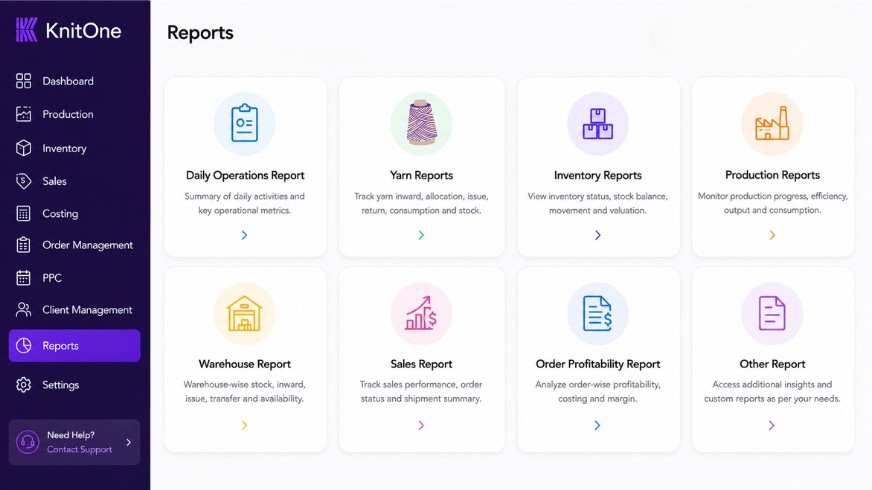
1. Daily Operations Reports
Daily operations reports of a knitwear factory reflect how orders and processes are moving through the knitwear factory. These reports usually include production updates, work in progress (WIP) or pending work, order movement, resource usage, and department-wise operational status.
With daily sweater manufacturing reports, the decision-makers can understand order status, resource utilization, production movement, shipment risks, and operational delays more effectively.
Interestingly, these reports can be made accessible to department heads of merchandising, production planning & execution, and human resources. This eventually reduces departmental silos while also fostering alignment and coordination.
2. Yarn Reports
Yarn reports are structured records of how yarn enters, stays, and moves within and around the factories.
Some of the major yarn reports are as follows:
- Yarn stock availability
- Issued and consumed yarn
- Locked yarn for orders
- Yarn rejection
These yarn reports for sweater manufacturers help provide clear traceability of yarn movement. Such yarn visibility in knitwear manufacturing helps merchandising, and production managers take timely action to prevent excess yarn buying, yarn shortages, and last-minute production interruptions.
3. Inventory Reports
Inventory reports in sweater manufacturing refer to reports that provide details about the availability, movement, and status of yarn, items, assets, and services in the factory.
These inventory reports for knitwear factories help factories maintain clearer stock visibility across yarn stores, accessories, and other items.
Because production and dispatch activities depend heavily on stock availability, inventory reports support stronger operational planning and material control.
4. Production Reports
Production reports for knitwear manufacturing are detailed documents that summarize exactly what the factory produced using the available resources. These reports cover the knitting and MUP departments.
In the case of knitting reports, factories can access machine-related reports reflecting utilization, efficiency, runtime, and downtime. Likewise, workers’ efficiency reports reflect the productivity and quality of work of the shop floor workers (MUP).
These production reports in knitwear manufacturing help the business owners and production managers understand the gap between the planned production timeline and actual production TNA (Time and Action chart).
With key insights on machine usage and worker efficiency, better strategies can be adopted for maximum productivity without putting extra pressure on resources.
5. Warehouse Reports
Warehouse reports are those reports that offer visibility into the movement of finished goods in and out of the warehouse. These reports provide details of the number of FG available along with their movement across the branches, return, and decommission.
These warehouse reports in sweater manufacturing help teams prioritize urgent dispatch, spot slow-moving stock for smart promotions, and keep warehouse counts accurate.
With connected warehouse reporting, factories can improve stock accuracy and maintain clearer dispatch readiness visibility across operations.
6. Sales Reports
Knitwear sales reports serve as summaries of overall and order-specific sales, showing what was sold, to whom, in what quantity, and with what business impact.
These reports include order fulfillment and sales status of finished goods in the warehouse. Knitwear sales reports support better decision-making by giving visibility into customer demand and order patterns.
By understanding patterns and trends in these reports, teams can prepare targeted strategies to improve each department’s productivity.
7. Order Profitability Reports
An order profitability report of a knitwear factory refers to a detailed balance sheet of the total costs for the factory to complete an order. The core of this report is to help business owners and production managers find the actual contribution margin of an order.
Order-specific profitability reports help management understand whether an order was completed within the estimated cost or if the actual cost exceeded it.
With the key insights, both sales and management teams can understand profit-yielding clients and make efforts to earn more orders from them.
With these reports, the trends, patterns, and gaps in various departments can be understood. Hence, businesses can make the right decisions at the right time, which can help achieve desired business goals.
However, there are still some challenges in acquiring precise departmental reports within sweater manufacturing. Let’s look into these challenges in detail.
Common Challenges in Acquiring Knitwear Reports
As sweater manufacturing operations grow, traditional reporting can blur operational visibility, which can lead to poor decisions. Now, let’s understand such challenges in brief.
a. Manual Follow-Ups Across Excel, Calls, and WhatsApp
Despite understanding the industry’s growing acceptance and efforts to make digital transformation, many sweater factories still rely on basic solutions. These solutions include Excel for calculation and tracking, along with files, phone calls, and WhatsApp groups.
Consequence of this challenge
These manual processes compel the relevant teams and HODs to spend more time following up for information instead of focusing on their core responsibilities of on-time and quality production. As a result, it weakens overall knitwear factory productivity and slows down operational coordination across teams.
b. No Real-time Reports Across Departments
With heavy reliance on traditional reporting, the key activities: panel movement, yarn issuance, MUP progress, etc., are often entered late or updated in batches after operations are already completed.
Not to mention, each department updates its information at different times. Also, they often maintain separate reports using different formats.
Operational impact of this challenge
Reports fail to reflect the actual factory situation during production execution.
c. WIP and Panel Movement Lack Centralized Tracking
Instead of using QR or RFID for SFG tracking, many factories still rely on manual reporting to track panel and WIP movement across departments.
In such cases, movement updates are recorded separately through registers, files, or manual entries rather than one connected system. This makes centralized tracking of panel status, location, and pending quantities difficult across factory operations.
Consequence of this challenge
Tracking panel location, pending quantities, and production stage movement becomes difficult across factory operations.
d. Weak Delivery Risk Tracking
In many factories, yarn, production, MUP, and dispatch reports are not clearly linked with buyer delivery dates and shipment commitments.
As a result, factories may track production activities separately without clearly understanding whether the order is still aligned with the planned delivery schedule.
Operational impact of this challenge
Factories struggle to identify which orders are at risk of delay before the delivery timeline is affected.
These challenges and their consequences show that reporting in sweater manufacturing is more than crucial. The reports are essential for turning scattered factory updates into clear and useful information.
When talking about factory reports, there must be a unified and connected reporting channel. And for that, ERP is the best answer. However, generic ERPs often fall short in knitwear manufacturing; tailored ERP for knitwear manufacturing, like KnitOne, works best. Further, KnitOne has key modules and provides relevant reports for sweater manufacturing.
Let’s now understand what KnitOne can provide for better reporting in sweater manufacturing.
How KnitOne Provides Detailed Reports Across Knitwear Operations
KnitOne is specifically built to digitize knitwear manufacturing by recording key factory activities from inventory to dispatch in one connected system.
Because every module works within the same platform, operational data stays unified across departments instead of remaining scattered across files.
With real-time dashboards and connected reporting, management gains clearer visibility into production progress, pending work, delivery risks, operational costs, capacity, and profitability. This supports better planning, team collaboration, coordination, and more confident decisions.
Final Thoughts
In knitwear manufacturing, reports do more than show numbers; they provide clearer visibility across key factory operations.
Production, inventory, warehouse, and delivery reports help teams monitor progress, track pending work, and improve operational coordination.
When reports stay connected and updated, factories can reduce manual follow-ups, improve coordination between departments, strengthen delivery control, and make faster operational decisions.
With KnitOne, sweater manufacturers can centralize reporting across departments and gain better visibility from yarn to dispatch.
Why wait? Boost Profits with KnitOne’s Complete Operational Visibility.
Frequently Asked Questions
1. Why Reports Matter in Knitwear Manufacturing?
Reporting matters in sweater manufacturing because it helps in:
- Live Visibility Across Orders, Yarn, and WIP
- Better Planning for Yarn, Machines, and Manpower
- Early Warning Before Delivery Delays
- Faster Identification of Production Bottlenecks
- Stronger Coordination Between Merchandising, PPC, and Production
- Easier Production Forecasting and Capacity Planning
2. What are the most important daily reports in sweater manufacturing?
The most important daily reports in sweater manufacturing include:
- Order Status Reports
- Yarn Inventory Reports
- Knitting Progress Reports
- WIP Tracking Reports
- Quality Reports
- Machine Capacity Reports
- Delivery Tracking Reports
- Production Reports
- Warehouse Reports
- Order Profitability Reports
These connected Daily Sweater Manufacturing Reports help factories improve operational visibility and production coordination.
3. Why are daily reports important in knitwear manufacturing?
The daily reports are important in knitwear manufacturing because they help factories:
- Monitor production progress
- Identify delays earlier
- Control yarn usage more effectively
- Improve production planning accuracy
- Maintain on-time delivery performance
- Track operational bottlenecks faster
- Improve coordination between departments
Reports that connect key knitwear operations aid in decision-making and factory control across operations.
4. How do real-time reports improve factory operations?
Real-time reporting in knitwear manufacturing improves factory operations by:
- providing live visibility across departments
- helping management make faster decisions
- reduce bottlenecks
- improve coordination between departments
5. What challenges do factories face without proper reporting systems?
The challenges that knitwear factories face without proper reporting systems include:
- Manual follow-ups through calls, Excel, and WhatsApp
- Delayed operational updates across departments
- Inaccurate production reporting
- Separate reporting systems across departments
- Difficulty tracking WIP and panel movement
- Reports disconnected from delivery timelines
- Non-standardized reporting formats across teams
Without connected reporting systems, overall knitwear factory visibility becomes weaker.
6. Which departments benefit the most from daily reporting?
The departments that benefit the most from daily reporting include Merchandising, Production Planning and Execution, Inventory and Warehouse Management, Quality control, Sales and Management/Business Owner.
7. How do reports in knitwear industry help improve on-time delivery?
Reporting helps the team to improve on-time delivery by:
- Showing yarn arrival pending
- identifying production delays
- Understanding bottlenecks
- Spotting At-risk orders early
8. How can ERP software improve reporting in sweater manufacturing?
ERP software can improve reporting in sweater manufacturing by centralizing data from different departments into one system. It reduces manual reporting and provides real-time visibility across yarn, production, quality, packing, and delivery operations.
KnitOne- a leading ERP for Sweater Manufacturers, improves visibility, coordination, and operational efficiency across departments.
9. Which reports help directly support yarn control in knitwear manufacturing?
Dedicated yarn reports given below help in yarn control in knitwear manufacturing:
- Yarn stock reports
- Yarn locking reports
- Yarn issuance reports
- Yarn purchase reports
- Yarn arrival reports
- Yarn wastage report
Overall, these yarn reports for sweater manufacturers improve yarn visibility and reduce shortages or overbuying.