
In sweater manufacturing, profitability is driven not only by machines, skilled workers, and material availability but also by effective merchandising.
Merchandising is a special department in sweater manufacturing that helps various departments within the factory. To be specific, order-related activities start and close with merchandising. Thus, merchandisers have a crucial role in making or breaking an order and bringing profits to the factory.
In this blog, we will dive deep into the merchandising of the knitwear industry. Let’s get started.
Key Highlights
- Merchandisers serve as the key link between buyers and factory operations.
- Merchandising & costing oversees order costing, buyer communication, vendor coordination for materials, and supports production planning.
- Effective merchandising enhances profitability, production planning, interdepartmental collaboration, order management, and transparent buyer communication.
- The key challenges in merchandising include costing discrepancies, facilitating coordination between inventory and production, and handling clients’ queries with delayed reports.
- KnitOne’s Merchandising & Costing module empowers merchandisers with up to 99% accurate costing and real-time order updates, streamlining workflow from order inquiry to delivery.
What Is Merchandising & Costing in Sweater Manufacturing?
Merchandising in sweater manufacturing refers to the process of managing buyer requirements, raw material coordination, production planning, and execution.
The professional who is involved in merchandising is called merchandiser/merchant; they act as a bridge between buyers, vendors, and factory operations.
Costing is one of the crucial responsibilities of a merchandiser. Here, they calculate, estimate, and finalize the total production cost of a sweater before order confirmation.
Together, merchandising and costing help factories plan orders accurately, manage buyer expectations, and prepare production teams with clear operational visibility.
Types of Merchandising & Costing in Sweater Manufacturing
Let’s now understand the various types of merchandising and costing done in sweater manufacturing.
Marketing Merchandising
This kind of merchandising acts as the first connection between the buyer and the factory. Handling communication with buyers, addressing order inquiries, negotiating prices, and overall marketing coordination are the key duties.
Planning Merchandising
Here, merchandisers coordinate with the production planning team to align orders with production capacity, timelines, and delivery schedules. They help decide when and how an order should move through production.
Production Merchandising
A production merchandiser manages all production-related activities. Once the TNA is finalized, they stay on the ground to ensure the order moves smoothly and is delivered on time.
Development Merchandising
A development merchandiser bridges the gap between creative design and manufacturing. They handle the technical reality and focus on transforming initial tech packs into finalized, market-ready products.
Sourcing Merchandising
In this, the merchandiser handles the procurement of yarn, trims, accessories, and other required materials for confirmed orders. They ensure the right materials are sourced from the vendors at the right price, quality, and time for production.
Note* Although visual merchandising is primarily used in retail, it is still gaining traction in knitwear indyustry. Here, merchants use samples, showrooms, and buyer presentations to showcase products.
Types of Costing in Sweater Manufacturing
Merchandisers are involved in estimating the cost for sample and bulk production, where it includes the following
- Direct/Variable Costing: Calculation of product costs using only expenses directly linked to production activities.
- Absorption Costing (Full Costing): It covers both direct production costs and fixed overhead expenses across manufactured products.
- Activity-Based Costing (ABC): Here, the cost is allocated based on the specific activities and resources consumed during production.
- Standard Costing: In this costing, predefined cost benchmarks are used to measure and control production performance.
Now, let’s understand the advantages of having strong merchandising.
Benefits of Robust Merchandising in Sweater Manufacturing
Merchandising serves as the connector between buyers and factory operations; thus, they have the pressure to deliver the best. For that merchandising has to be stronger and more goal-driven.
Below are some of the benefits of merchandising explained:
1. Profitable Costing & Margin Control
Strong merchandising helps the factory prepare costing in a way that protects business profitability while keeping buyers satisfied.
For both sample and bulk orders, the merchandiser calculates costs accurately by considering estimated material cost, production charges, wastage tolerance, process requirements, and delivery expenses.
With this costing clarity, the factory can avoid accepting orders with weak or unclear margins.
2. Improved Production Planning
Merchandisers hold a key role in forming the TNA (Time and Action Calendar)-a crucial part of production planning and control in the factory.
They prepare and monitor the TNA, coordinate material readiness, and align delivery commitments with production capacity.
With this, there are fewer chances of last-minute changes and confusion on the production floor. A smart merchant can even facilitate adaptive production planning if they introduce ERP solutions like KnitOne in their factory.
3. Stronger Interdepartmental Coordination
Correct and faster costing gives all departments clearer order information at the right time.
With costing and TNA clarity, merchandisers can:
- Guide inventory and procurement teams to arrange materials faster
- Support the knitting team with defined start and completion timelines
- Help the delivery team prepare according to the committed shipment date
Eventually, it improves internal coordination and helps prevent delays caused by missing details, late approvals, or disconnected communication.
4. Enhanced Order Management
Stronger merchandising improves order management because the merchandiser keeps all order details complete and updated from the beginning.
When these details are managed properly, the factory can track where the order stands, what is pending, and which department needs to act next. This reduces missed approvals, wrong production instructions, material delays, and last-minute confusion.
5. Better Buyer Communication
One of the crucial jobs of merchants is to talk with buyers, verbally or via email. Dedicated merchandising and better SFG tracking facilitate clear communication with buyers about the order progress.
Not just that, they also ensure on-time delivery for every order. Such professional service builds a better impression among the buyers. This, hence, contributes to bringing profitable buyers and orders in the future.
Merchandising Process in Sweater Manufacturing
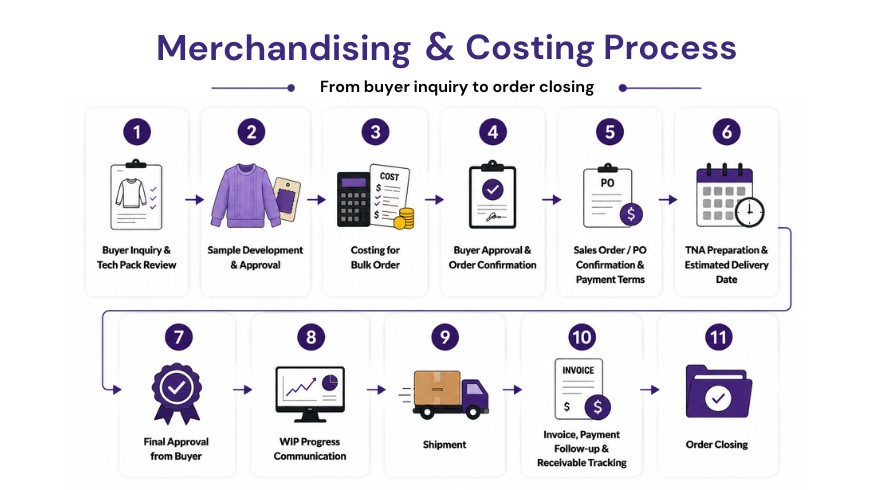
The merchandising & costing process includes:
- Buyer inquiry and tech pack review
- Sample development and approval
- Costing for bulk order
- Buyer approval and order confirmation
- TNA preparation and estimate delivery date
- Final approval from the buyer
- WIP progress communication
- Shipment
- Order closing
Below is the pictorial representation of the merchandising process in knitwear manufacturing.
Common Challenges in Sweater Merchandising & Costing
Merchants hold an important role in the factory operations as they are involved in material sourcing, costing, planning, production, communication, and follow-ups.
Due to immense pressure and expectations, merchants have their own type of professional challenge, mostly in maintaining costing accuracy, coordinating inventory and production, and communicating with clients.
Although skilled and experienced, the use of legacy systems in the factory can indirectly affect their productivity, hence becoming a challenge for merchandisers in knitwear manufacturing.
For details on challenges, especially in costing, read our blog on Costing Concerns of Knitwear Merchandisers in Bangladesh.
However, solutions like ERP for sweater manufacturing can help merchandisers tackle these challenges. How? Let’s find that in the other section.
How KnitOne Helps Manage Merchandising & Costing in One System
KnitOne – a tailored ERP for knitwear manufacturing, has a dedicated module to ease and systematize ‘merchandising’ processes.
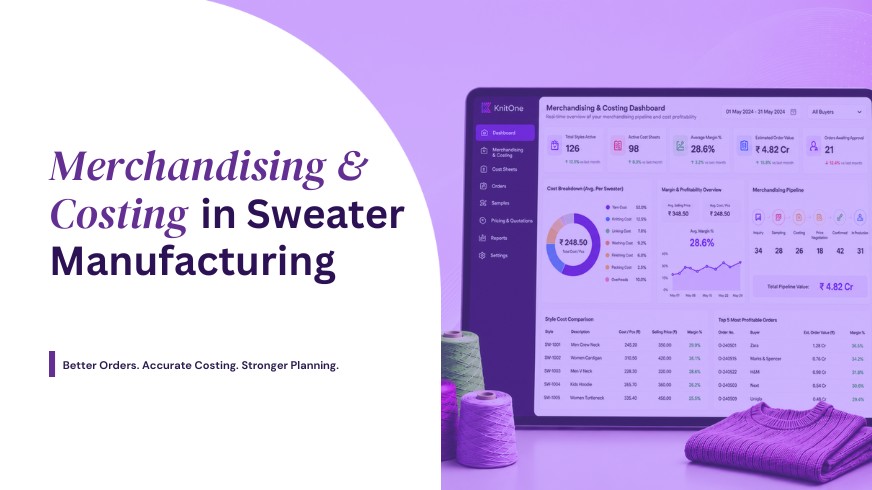
The Merchandising and Costing module is developed using KnitOne Intelligence. Here, the style, order, and client details are synced to estimate the up to 99% accurate cost for sample/bulk orders.
Interestingly, merchandising is connected with order profitability; this helps the merchandisers, sales, and managers to understand what was planned in costing and what was executed. Using the insights, merchandisers can formulate better and more profitable costing for upcoming orders.
Final Thoughts
Merchandising and costing in sweater manufacturing are crucial for operational efficiency and profitability.
In short, merchandisers act as a connecting point between buyers, vendors, and other departments, aligning production and procurement. Most importantly, merchandising ensures accurate costing, effective coordination, timely delivery, and profitable order execution.
Industry-specific solutions like KnitOne focus on aiding the merchandisers in their duties with stronger costing, better buyer-factory relations, and connecting workflows from order inquiry to delivery.
Why wait? Boost Profits with KnitOne’s Complete Operational Visibility.
Frequently Asked Questions
1. What Is Merchandising in Sweater Manufacturing?
Merchandising in sweater manufacturing refers to a department that is responsible for buyer communication, sampling, approvals, costing coordination, and production preparation.
2. What Is the Role of a Merchandiser in Sweater Manufacturing?
The role of a merchandiser is to ensure smooth order execution through buyer coordination, costing, approvals, material follow-up, and collaboration with production planning teams.
3. What Is the Role of Buyers, Vendors, and Merchandisers in Sweater Manufacturing?
Buyers place orders, vendors supply materials, and merchandisers coordinate communication, approvals, costing, and production planning.
4. What Are the Key Features of Merchandising?
The following are the key features of merchandising:
- Buyer communication management
- Style and order development
- Sample tracking and approvals
- Bill of Materials (BOM) preparation
- Costing coordination
- Vendor and sourcing management
- Order tracking and follow-up
- Production readiness management
- Delivery schedule coordination
5. What Is Costing in Sweater Manufacturing?
In sweater manufacturing, costing is the process of calculating the estimated production cost of a sweater order.
6. What Details Are Needed for Sweater Costing?
Sweater costing typically requires:
- Tech pack specifications
- Yarn consumption
- Trims and accessories
- Gauge and stitch details
- Style complexity
- Labor costs
- Finishing costs
- Packaging costs
- Shipping or logistics costs
7. Why Must Costing Be Done Before Confirming an Order?
Costing must be completed before order confirmation to ensure the quoted price covers all production expenses and protects factory profitability.
8. Why Is Accurate Costing Important in Sweater Manufacturing?
Accurate costing in sweater manufacturing is important because it helps in maintaining profitability and reducing financial risks.
9. How Does Merchandising Support Production Planning?
Merchandising supports production planning through TNA management, approvals, costing, BOM preparation, and material readiness, helping PPC plan production effectively.