
In sweater manufacturing, one factory day carries a lot of movement.
Yarn may be issued. Panels may be knitted. Machines may stop and restart. Orders may move from one stage to another. Some pieces may go for rework. Some may get rejected. Buyer commitments may also come closer without waiting for the factory to catch up.
So, when you ask, “How was the factory day?” The answer cannot come from only one report.
This is why daily summary reports in sweater manufacturing are important.
These reports are not just records. They are your factory’s daily mirror. They help you understand what went well, what slowed down, what needs attention, and what tomorrow should begin with.
In this blog, we will discuss the crucial daily summary reports every sweater manufacturer should have to understand better factory performance, reduce confusion, and make better production decisions.
The Reports Every Sweater Manufacturer Should End the Day With
As a sweater manufacturer, you should not have to depend only on verbal updates, scattered Excel files, or department-wise follow-ups to understand your factory day.
You need clear daily reports that show production, machine utilization, WIP movement, rework, rejection, and sales-related updates.
Let’s understand what these reports convey and how they help you make beneficial decisions.
1. Production Reports — See What Your Factory Brought to Life Today
A sweater factory does not run without a production plan. Your production manager prepares the plan so that the team can follow the target for the day.
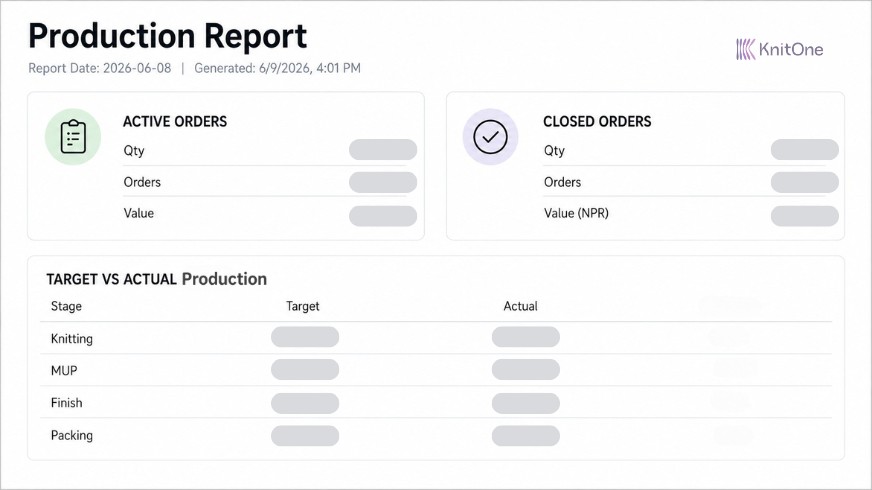
In the morning, the plan may look clear and achievable. But by the end of the day, you need to know what actually happened to that plan. This is where production reports become important.
Production reports depict:
- What was produced in the factory, including bulk and sample production.
- Which orders were cancelled, closed, open, or still in production.
- How much yarn was wasted or lost during the day.
- Whether actual production matched the targeted production planning
Actions you can take with production reports:
- Identify production gaps by comparing planned output with actual output.
- Investigate delays caused by manpower, materials, machines, or process issues.
- Reallocate resources and adjust production schedules to recover lost output.
- Prioritize at-risk orders to maintain production flow and meet shipment deadlines.
2. Machine Activity Reports — The Heartbeat Behind Every Shift
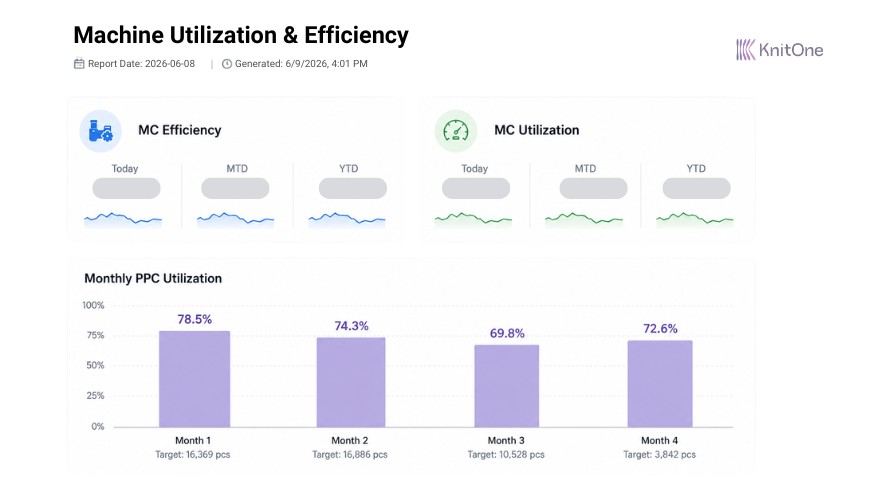
Machines are the rhythm of a sweater factory. They create panels for different styles and directly affect daily production output.
When machines run well, production moves smoothly. When they stay idle or stop due to different reasons, delays start affecting the plan immediately.
Machine Activity Reports give you clear details of machine performance across shifts, whether day shift or night shift.
These reports show detail on:
- Which machines were running during the day.
- Which machines were idle or stopped.
- How much output each machine generated.
- Machine-wise running time, idle time, and downtime.
- Whether machine performance was as per the production target.
All in all, machine activity reports give you, your production team, and management a clear view of how machine activity affects daily production.
Actions you can take with machine activity reports:
- Identify machines with low output, high idle time, or repeated stoppages.
- Investigate reasons for sudden downtime or breakdown.
- Reassign work to better-performing machines where possible.
- Adjust machine loading and next-day production planning based on actual machine performance.
- Take early technical action before machine issues affect delivery timelines.
3. WIP Reports — Where Today’s Production Is Still in Motion
Once knit panels are produced, they still need to move through different stages before becoming finished garments (FG). Panels may need linking, dyeing, washing, finishing, checking, or packing, depending on the order process.
This movement is recorded in the Work-in-Progress, or WIP Report.
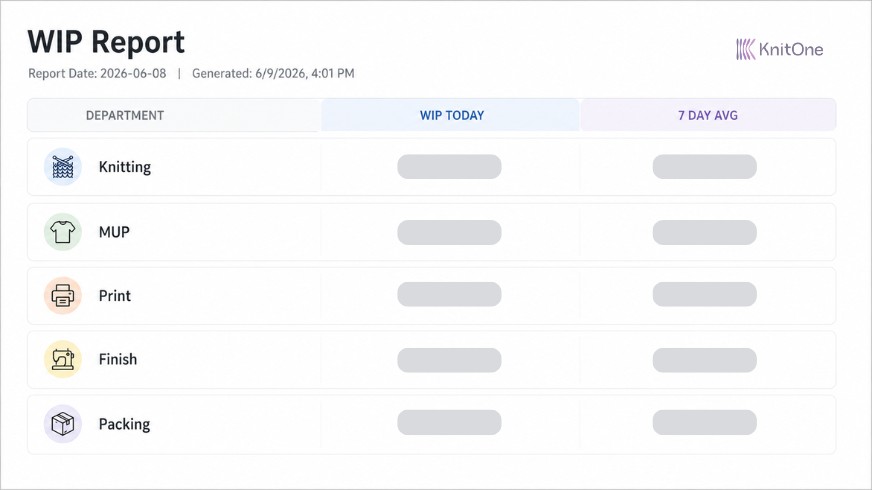
With this report, you and your production team can clearly see how many pieces are waiting at each production stage, such as knitting, dyeing, linking, washing, finishing, or packing.
If pieces get stuck at one stage, the entire order completion process can slow down. This is why efficient SFG tracking is important. Manufacturers can use QR or RFID-based SFG tracking to follow semi-finished goods more accurately.
Actions you can take with WIP reports:
- Resolve bottlenecks by reallocating manpower or machine capacity.
- Prioritize delayed or urgent orders to avoid shipment delays.
- Balance workloads across departments to maintain smooth production flow.
- Investigate recurring delays and apply corrective actions to improve efficiency.
4. Rework & Rejection Reports — The Moments Worth a Second Look
Not every piece moves perfectly through the factory.
During quality checks, some panels may be rejected. Some may need to be reworked, some reknitted, and some can be replaced.
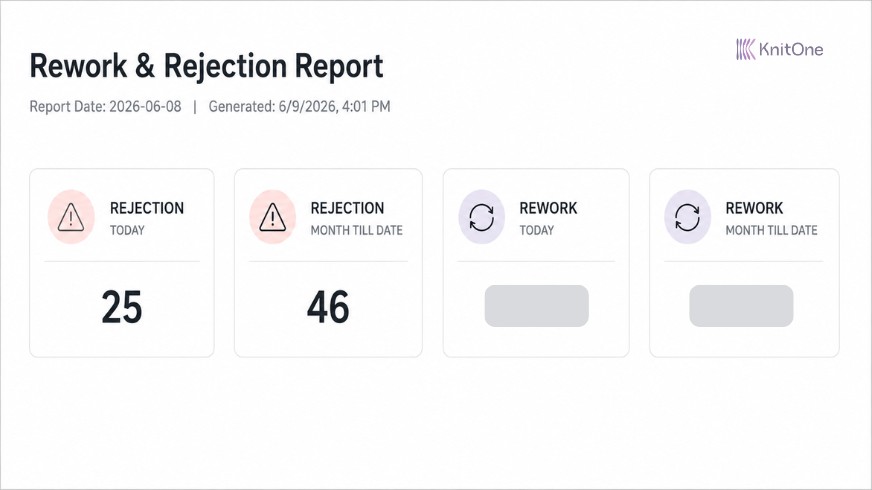
In sweater manufacturing, rejection affects material, machine time, manpower, delivery planning, and profitability. The cost of rejection may look small in the beginning, but repeated rejection can reduce the profitability of an order over time.
This is why rejection reports are crucial.
A rejection report includes data on panels or garments that fail to meet quality standards and cannot move to the next production stage. It captures rejected quantity, rejection stage, defect type, affected style or order, and reason for rejection.
Actions you can take with rejection reports:
- Identify whether rejections are coming from a specific machine, operator, production line, or process.
- Apply targeted corrective actions, such as recalibrating knitting machines or adjusting linking tension.
- Strengthen quality control by increasing in-line inspections.
- Prioritize replacement production to protect delivery timelines.
- Review high-rejection styles before they affect order profitability.
5. Sales Reports — Factory Output Tied to Real Buyer Commitments
Sales reports help connect what your factory produces with what has been committed to buyers.
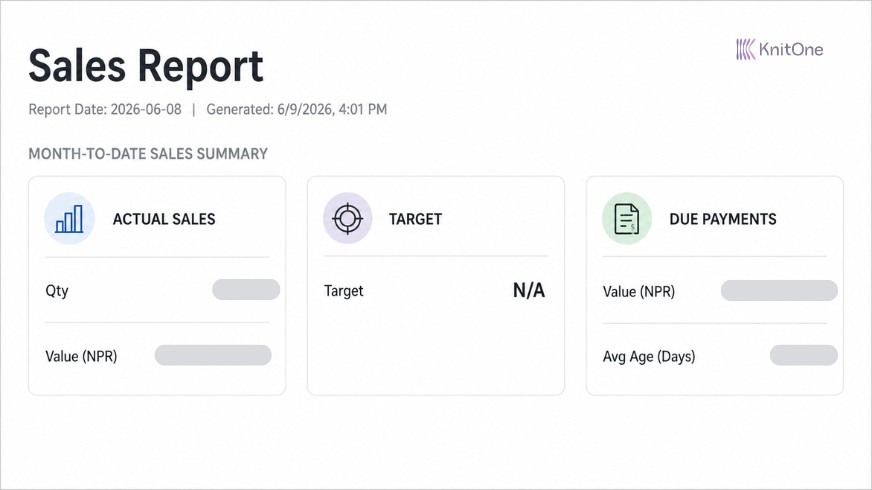
These reports help sales, merchandising, production, and management teams see confirmed orders, dispatch updates, sales movement, and how factory progress is supporting buyer commitments.
Actions you can take with sales reports:
- Merchandisers can immediately update buyers on order status, dispatch progress, and any delivery risks using confirmed daily factory data.
- Management and factory owners can spot risks, delays, high-value orders, capacity conflicts, or buyer escalations.
- You can push priorities internally, approve urgent support, or ask PPC, production, or dispatch teams to correct the gap.
Overall, these daily reports in sweater manufacturing aid in improving production planning, production, order management, buyer communication, delivery planning, and overall business control.
Read More: What are the Important Reports for Sweater Manufacturers?
But the secret to unlocking the hidden costs and inefficiencies in your sweater manufacturing is not looking at these factory reports separately. The real value begins when the factory sees them together.
Why Choose KnitOne for Complete Sweater Factory Reporting?
In many knitwear factories, daily reporting becomes difficult because every department prepares updates separately. Each report is prepared after collecting information through follow-ups, Excel files, phone calls, or verbal communication.
KnitOne, a tailored ERP for knitwear manufacturing, helps reduce this reporting dependency by allowing these reports to be prepared directly from the ERP. This means you do not need repeated manual effort or wait for department-wise updates. As a result, daily reporting becomes faster, clearer, and more useful for management.
With WhatsApp integrated into the ERP, these day-end reports can also be shared directly with the factory owner, management team, or selected department heads. This ensures that the right people receive the right reports at the right time. For a factory owner, this creates a major advantage as:
- You do not have to wait for someone to manually prepare a summary after the day ends.
- You can receive key factory reports and review production, machine activity, WIP, rejection, and sales movement with greater confidence.
Not just reports, but you can also view the KnitOne dashboard to check progress in various departments over a period of time.
Final Thoughts: Closing the Factory Day with Confidence
Daily reports in sweater manufacturing help you close each day with answers, not assumptions.
They help you understand whether:
- Production followed the production plan.
- Machines were properly utilized.
- Breakdowns affected output.
- Panel rejection and rework affected production.
- Orders are moving as expected.
- Buyer commitments are still protected.
- The factory needs to speed up, adjust, or continue at the current pace.
With these daily reports, you gain clearer visibility across key factory operations. This visibility helps you understand whether production needs to accelerate, slow down, or continue at the present pace to stay aligned with seasonal production goals, buyer deadlines, and delivery commitments.
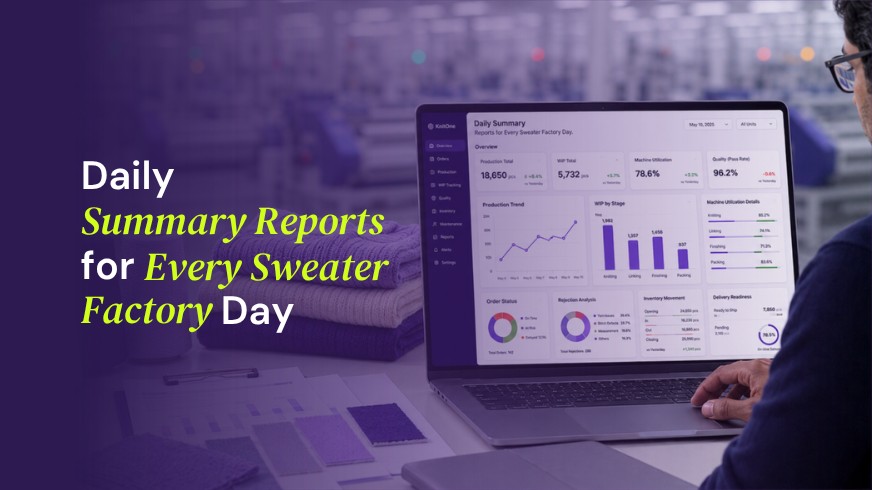
KnitOne prepares these critical Daily Summary Reports so you can understand daily productivity, bottlenecks, gaps, and inefficiencies inside the factory.
When needed, you can take timely action to improve production flow and protect delivery commitments.
Why wait? Boost factory visibility with KnitOne’s complete operational reporting.
FAQs
What are daily summary reports in KnitOne?
Daily Summary Reports in KnitOne are day-wise reports that bring important factory activities: production output, machine activity, rework, rejection, order progress, and sales updates into one clear view.
What types of reports are included in KnitOne daily summary reports?
KnitOne daily summary reports can include:
- Production Reports
- Machine Activity Reports
- Rework & Rejection Reports
- Order Reports
- Sales Reports.
Together, these reports show what happened during the day and where the factory needs attention.
How do daily summary reports help sweater manufacturers?
Daily reports in sweater manufacturing help teams:
- Identify delays, track output
- Monitor machine performance
- Control rework and rejection
- Follow order progress more clearly.
They support faster decisions and reduce dependency on scattered manual updates.
Can KnitOne help reduce manual daily reporting?
Yes, KnitOne can help reduce manual daily reporting by bringing important factory updates into one system. This reduces the need for repeated Excel sheets, WhatsApp follow-ups, verbal updates, and department-wise manual report collection.
Who can benefit from Daily Summary Reports in KnitOne?
Daily summary reports in KnitOne can be used by:
- Factory owners
- Factory owners
- Management teams
- Production teams
- Merchandising teams
- Sales teams