

In sweater manufacturing, rejection is inevitable. But the bigger question is, how much profit is being lost every time a panel is rejected?
For cotton-based knitwear production, a 3–5% panel rejection rate may still be manageable. But in luxury knitwear, where yarns like merino wool and cashmere carry a much higher value, the same rejection rate can become a serious profit leak. A 5% rejection-driven yarn loss can translate into nearly $150,000 in annual cost for premium yarn consumption.
That is why internal/in-factory panel rejection cannot be treated as routine production loss.
In this blog, we will look into the details of rejection within the factory. But first, let’s understand how exactly rejection drives higher costs and affects the committed delivery schedule.
How Rejection Affects Factory Cost and Delivery Commitments
The core of sweater production is yarn; it makes 40% to 60% of the garment’s total value. When a panel is rejected, the defect type and location are first identified.
In short, panel rejection impacts cost and delivery in five major ways::
- Panel rejection increases direct material cost because yarn contributes around 40%–60% of garment value.
- Major defects require reknitting, which adds extra yarn, machine time, labor, and production effort.
- Recovered yarn may lose quality, especially in cashmere and fine merino, creating margin loss or decommissioning risk.
- Rejection slows the production cycle because teams spend time replacing panels instead of moving orders forward.
- Delivery delays increase factory cost through overtime, penalty charges, and loss of buyer trust.
To understand this better, minor defects can be repaired, while major knitting defects often require the panel to be replaced. In such cases, the rejected panel may be rewound to recover usable yarn and then re-knitted.
Even after the yarn is recovered, it may not always retain its original quality, particularly in premium yarn such as cashmere and fine merino wool. In severe situations, such yarn can get decommissioned by sales under margin or defacing, which makes a direct hit to the profits, increasing the factory costs.
In such a situation, to complete an order, the new panel must be knitted, which means more yarn, machine, and workforce. Ultimately, this operational friction creates delays in schedules that force the floor into expensive overtime shifts just to catch up.
Interesting Fact: Dr. Rajesh Bheda studied 61 major apparel manufacturing factories in India and found that factories lost an average of 9.36% of their top-line annual sales revenue to Internal Failure Costs such as scrap, rework, and mending (FibretoFashion).
An order must be completed, whether the factory has constant quality production or repeated rejection and rework. For that, more resources and time are needed to knit, link, and finish and complete the order.
Because the factory spends additional time reproducing rejected panels instead of moving forward, the production cycle stretches beyond the planned schedule. This ultimately pushes the delivery date beyond the committed date.
And missed delivery commitments don’t only damage buyer trust but also lead to penalty charges, again adding to the factory costs.
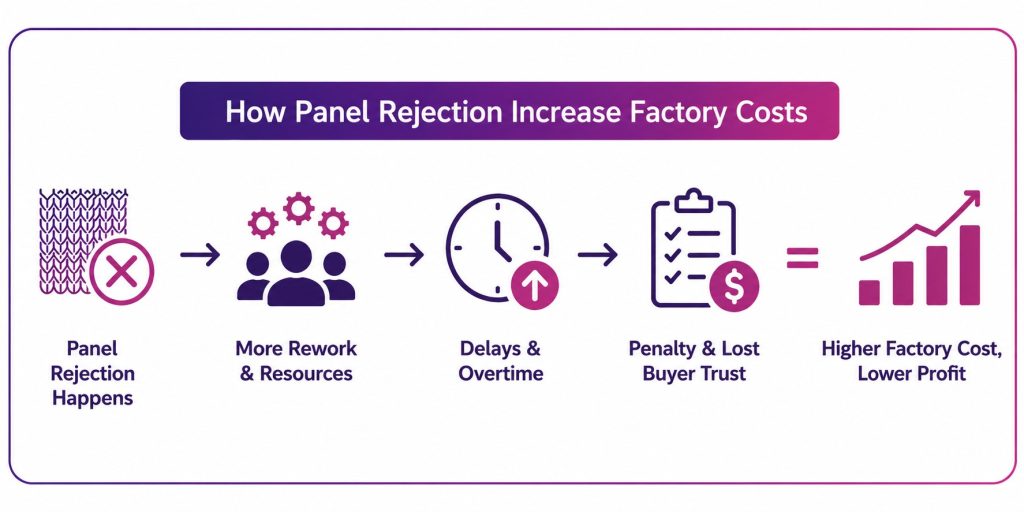
Overall, internal rejections add up to the target production cost due to more resource usage and a penalty for delayed delivery.
Let’s now get into the value of costs on various factors for rejection.
Rejection-Driven Cost Leakage in Knitwear Factories
Internal factory rejection of panels and garments compels yarn wastage, machine overwork, and overtime, increasing the costs. Let’s get into the numbers.
1. Extra Yarn Consumption
Depending on defect severity, rejected pieces may require repair, rework, or replacement production. Extra yarn consumption occurs when rejected panels need to be replaced. This means additional yarn consumption beyond the planned order quantity.
In fact, if a factory has 5% of panel rejection rate, it can translate to a 2–3% increase in yarn cost per order.
For example, on a $100,000 yarn order, even a 5% rejection rate means $2,000–$3,000 worth of yarn is lost. The number for loss is scarier for premium yarns like merino or cashmere.
2. Rework, Reknitting and Additional Labor Cost
Sweater manufacturing is worker-driven, with labor often accounting for 20–35% of factory production cost. When panels are rejected, the factory spends additional manpower on repair, rework, reknitting, replacement production, checking, and supervision. This increases the cost of the factory.
For example: Making 10,000 sweaters at $1.50 labor cost per piece means the factory already plans $15,000 in labor cost. But if 3–5% of those pieces come back for rework or replacement, the factory ends up paying extra labor on the same production, adding around $450 to $1,875 beyond the planned budget.
3. Machine Downtime Cost
The actual process of sweater manufacturing starts with knitting done by machines. These high-tech machines are from brands like Shima Seiki, Cixing, Stoll, etc.
When rejection and rework increase, machines scheduled for regular production must also handle replacement knitting. This extra load can reduce available maintenance time, disturb machine allocation, and increase the risk of downtime if machine care is delayed.
4. Washing and Finishing Cost
In some cases, defects such as color bleeding, shrinkage, shiny marks, and broken seams only reveal themselves after washing and finishing. This calls for garment rejection.
Rejection at this stage feels like true failure since the garment already passed through every earlier quality check and has gotten washed, softened, steamed, and pressed.
And real pain is that the rejected garment, after possible mending, goes through all of the processes again. It’s in the factory to pay bills twice on the same piece.
5. Overtime and Shipment Pressure
When garments or panels are rejected, the entire production schedule gets squeezed. And to meet the shipment deadline, factories often push workers into overtime.
According to ILO guidance, overtime should be paid at a higher rate than normal working hours. In many labor systems, this increases factory labor cost whenever rejection forces workers into extra hours.
But overtime alone can’t ensure timely delivery; for that, factories mostly make expedited shipping. Instead of normal sea freight, they use air freight to send orders faster. And the air freight is typically 4 to 6 times more expensive than sea freight. This means extra cost to the factory.
Well, these were the rejection-driven cost leakage that occurs in sweater manufacturing factories. But the question is, why do they become prevalent? The possible reasons are explained below.
Why Sweater Manufacturers Struggle to Measure Rejection Cost
Most factory owners focus on profits but rarely pay close attention to rejections. The biggest reason is simple — they do not realize how much ignoring quality is actually costing them.
Beyond that, there are a few other reasons why measuring rejection cost remains a blind spot in most factories. Let’s understand in detail.
1. Manual Tracking Limitations
Most sweater manufacturers still record rejections on paper sheets or basic spreadsheets. This means data is recorded late, inconsistently, or sometimes not at all.
By the time these numbers reach management, the true cost of what was rejected is already buried. This means it is impossible to trace back rejection accurately.
2. Missing Rework Visibility
When a panel or garment is assigned for rework, it rarely gets logged as a separate cost event. It just quietly re-enters the production line.
No one records how long it took, which worker handled it, or what materials were used again. The rework happens, but the cost of it never appears anywhere on the cost sheet.
3. Lack of Department-Wise Accountability
Rejection can take place in knitting, linking, washing, or finishing. But in many factories, the cost is treated as a general production loss.
The problem is not traced back to the department where it started. So, no department becomes directly accountable. As a result, the cost spreads across the factory and becomes hard to see.
We discussed the process, the root causes, and the costs of internal rejection in the knitwear factory. Now, let’s get into finding solutions that actually help reduce rejection and save costs.
How to Reduce the Cost of Rejection
Since the cost of rejection is high, especially for luxury knitwear manufacturers, it is a must to minimize the rate of rejection. Detailed explanations of ways to reduce rejection costs are provided below.
1. Aggressive Quality Checks at Every Process
Rejection cost can be reduced when defects are caught early, not after the garment reaches the final stage.
Aggressive checking at knitting, linking, washing, finishing, and packing helps stop defective panels from moving forward and creating bigger losses.
2. Improve Machine and Process Control
Many rejections happen because machines are not maintained, settings are incorrect, or processes are not followed properly.
Regular machine checks, needle replacement, and process control help prevent repeated defects before they affect bulk production.
3. Strengthen Worker Accountability
Workers and supervisors should clearly know which processes, quantities, and defects are connected to their responsibilities.
When worker accountability is visible, production teams become more careful; repeated rejections, mistakes, and reworks can be controlled faster.
4. Monitor Each Rework Separately
Rework should not be mixed with normal production because it hides the real cost of rejection.
Tracking every rework separately shows how much extra time, labor, material, and machine effort are being used to recover rejected pieces.
Honestly, for these solutions to be implemented, digital transformation in sweater manufacturing is necessary. And this transformation is possible with an ERP solution.
But not just a generic ERP, an industry-specific ERP like KnitOne. But how can it actually help reduce rejection? We have covered that in the next section.
How Can KnitOne Help Track and Reduce Rejection Costs?
KnitOne is a tailored ERP for sweater manufacturers. It is equipped with the solutions built with KnitOne Intelligence that serve the core aspects of sweater manufacturing.
In regard to rejection within the factory, various features of KnitOne directly or indirectly cater to this. Let’s get into the details of such features.
1. Detailed Rejection Reports
Whether internal or external, rejection is nearly impossible to completely wipe them off from the sweater factory. However, it can certainly be reduced with dedicated rejection reports.
These reports should have details on how much and why the pieces were rejected for an order. Further, the report can be analyzed, and the major reasons for rejection, along with the patterns or trends in rejection, can be understood. Lastly, practical solutions can be recommended and implemented.
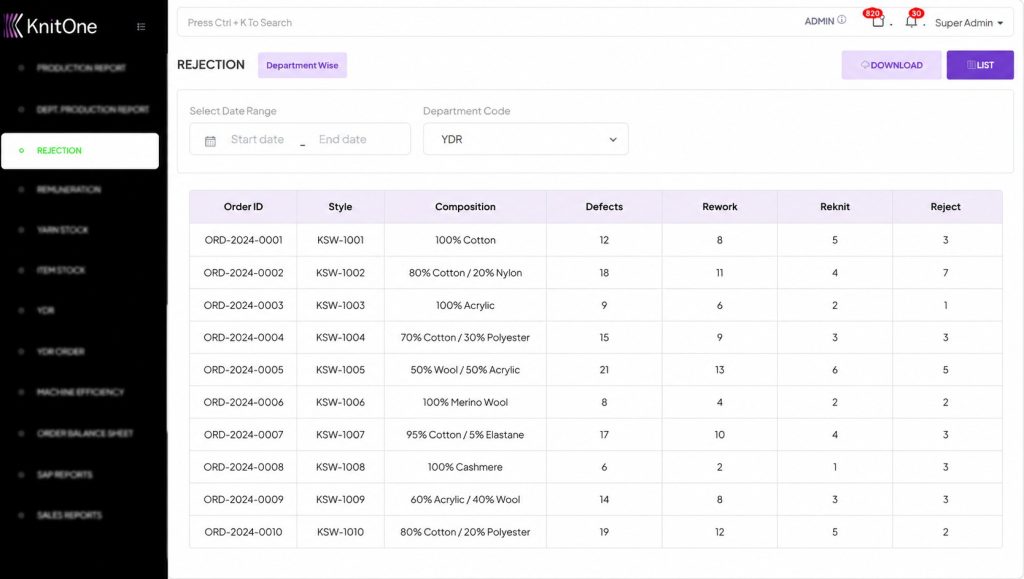
Department-Wise Rejection Visibility
KnitOne ensures better tracking of internal rejection in YDR (Knitting), Linking, and Finishing departments.
With a few inputs, such as date and department type, you can identify which orders, styles, machines, or departments generate the highest rejection levels.
Utilizing those insights, sweater manufacturers like you can enable corrective actions faster and have better production control.
Read our blog Important reports of knitwear manufacturing to know more about KnitOne Reports.
2. PPC for Better Production Control
One of the core reasons for panel rejection is due to faulty knitting, which is often related to machines.
This is not based on the brand of the machine; rather is based on providing machines with the required downtime and maintenance. However, this is often missed out as factories are seen adopting reactive rather than adaptive production planning.
Knitone offers Production Planning and Control module, which helps in estimating the viable delivery date for the orders with defined TNA, along with required machines, gauges, and manpower.
3. Rework and Loss Tracking
Rework occurs when defective panels need to be corrected to meet quality standards. With each piece adding up for rework, production time, labor, and costs increase. Needless to say, rework does reduce overall order profitability.
KnitOne ERP tracks rework across the production process. With insights on rework, the managers can identify the worker with the maximum reworks and find out what is leading to this situation and what solution to adopt to reduce it.
Final Thoughts
In sweater manufacturing, panel or garment rejection within the factory is of the major cost-drivers. Rejection can quietly increase yarn usage, labor cost, machine time, washing cost, finishing cost, overtime, and delivery pressure.
When rejection is not tracked properly, factories fail to see where the actual loss begins. Manual records, hidden rework, and weak department-wise accountability make the cost harder to control.
In order to reduce rejection, the following are necessary:
- stronger check for defects (CFD)
- better machine utilization with production planning
- worker efficiency and accountability tracking
- separate rework tracking.
With KnitOne Intelligence, manufacturers can take hold of the rejection with a detailed rejection report. They can improve production with stronger production planning, including machines and manpower.
Why wait? Boost Profits with KnitOne’s Complete Operational Visibility.
Frequently Asked Questions
What is an acceptable rejection rate in sweater manufacturing?
In general, an acceptable rate in sweater manufacturing is 3–5%, while sophisticated factories aim for under 3% common in many knitwear factories.
In case of buyer rejection, it depends on AQL (Acceptable Quality Level), AQL for minor defects is 4.0% while for major defects it is 2.5%.
Does the rejection rate vary with the yarn used?
Yes, the rejection rate varies significantly with yarn type, but specific rejection percentages by individual yarn type are not standardized by industry figures.
Can the quality of raw materials trigger rejections?
Yes, the quality of raw materials triggers rejections. Poor yarn quality, shade variation, contamination, and accessory defects are among the common causes of rejection in knitwear manufacturing.
How does rejection affect sustainability practice in the knitwear industry?
Rejections can significantly affect sustainability in the knitwear industry by increasing textile and resource waste, and carbon emissions.
What is the role of merchandisers in reducing rejection?
When a merchandiser builds an order costing, they already factor in a tolerable rejection rate as an acceptable production loss. The problem starts when rejection goes beyond that tolerance. At that point, it is the merchandiser’s responsibility to identify it, coordinate with the production team, and make immediate decisions before the cost goes beyond what was originally budgeted.
How to resolve buyer rejection?
You can resolve buyer rejection by:
- Acknowledging the rejection calmly and professionally
- Asking for specific feedback on what went wrong
- Fixing defective items or making replacements at no cost
- Showing proof of the problem being fixed
- Following up politely without pushing the buyer
Is rejection in the knitting industry completely avoidable?
No, rejection in the knitting industry is not completely avoidable.
Even in the most advanced factories, achieving a “zero percent” rejection rate is unrealistic due to the inherent nature of sweater manufacturing.