
Sweater orders are coming in, yet the factory is struggling to deliver on time. Late deliveries are leading to heavy compensation, and you may even be on the verge of losing your buyers. Does this sound familiar?
If yes, it is high time to understand that this problem isn’t resource-oriented, rather it is due to low adherence to the defined TNA calendar. But the question is, how can this problem be solved?
Well, for production to be on time and of high quality, the top-most priority is having strong production planning. And this is where Production Planning and Control (PPC) comes into play.
But what is PPC?
In this blog, we will look into the details of Production Planning & Control in Sweater Manufacturing step by step.
KEY HIGHLIGHTS
- PPC is the roadmap that drives an order from confirmation to delivery.
- PPC helps keep timelines on track, reduce delays, and improve factory coordination.
- Merchandisers set the timeline (TNA) for production while production managers turn it into floor execution.
- The TNA locks in dates for yarn, approvals, production stages, and shipment.
- Machine planning ensures the right load and adequate line for order completion.
- Manpower planning estimates the number of operators and MUP workers needed before production starts.
- Manual production planning leads to errors, miscommunication, and poor production visibility.
- KnitOne ERP connects planning, production, inventory, and WIP in one place.
What is Production Planning & Control (PPC) in Sweater Manufacturing?
PPC (Production Planning and Control) is the process of planning and managing knitwear manufacturing for sample/bulk orders, using a standard Time and Action (TNA) calendar to meet time commitments.
In simple words, PPC is planning the entire sweater manufacturing process from order confirmation to delivery.
Interestingly, production planning is also connected with supply chain forecasting. Production planning executes confirmed buyer orders, while forecasting helps factories prepare earlier for expected material, lead time, machine, and manpower needs.
Who makes the Production Plan in the knitwear factory?
To prepare a production plan in the sweater industry, both the merchandiser and the production manager are involved.
Merchandisers make the initial plan. They look at the buyer’s shipment deadline and work backward to create the dates.
The Production Manager then makes the actual execution plan. They take the merchandiser’s dates and turn them into machine numbers and operator targets.
Why is PPC Important in Sweater Manufacturing?
PPC is important in sweater manufacturing because it serves as a standard blueprint for the production of locked orders.
Further, sweater manufacturers need PPC to:
- Improve production planning accuracy
- Help maintain delivery timelines
- Reduce production delays
- Improve intradepartmental coordination
- Have better production control in future
- Leverage available machine and manpower
Key Features of PPC
For production planning to actually have an impact, it should have robust features that help in making the targeted PPC match the actual production timeline.
Let’s look into the key features of an effective PPC for sweater manufacturing:
- Production Plan and Scheduling
This feature helps production managers plan each sample or bulk order. The TNA estimation helps define the time/date for material/yarn arrival, knitting start and end time, and order delivery.
- Machine Capacity Planning
In order to make production plans, finding the available number of machines is crucial.
With organized production planning, machines are utilized such that they won’t be overloaded, and necessary downtime can be scheduled. This supports the right knitting machine allocation based on style complexity and production requirements.
- Manpower allocation
PPC not only helps in leveraging the right number of machines, but it also helps in leveraging skilled manpower.
With a clear understanding of style, the number of workers needed for linking, mending, trimming, and packaging is estimated. This helps avoid the last-minute worker’s need and delivers orders on time.
What are the Benefits of PPC?
The main benefit of PPC is to stay prepared to execute the order as planned. And when planning aligns with actual execution, it helps factories reduce uncertainty, improve resource use, and manage production flow more effectively.
Let’s look into the other benefits of PPC in sweater manufacturing:
- A strict adherence to PPC helps complete and deliver orders on time.
- Reduced confusion on the shop floor
- No more reactive production, no last-minute costly purchases
- Faster decision-making in prioritizing production
- No more abrupt machine issues due to effective machine planning
- Improved manpower productivity on production floor
- Production schedule visibility aids in achieving daily target management
- With the PPC insights, better production planning can be done in future.
PPC Process in Sweater Manufacturing
Let’s look into the steps involved in PPC of sweater manufacturing:
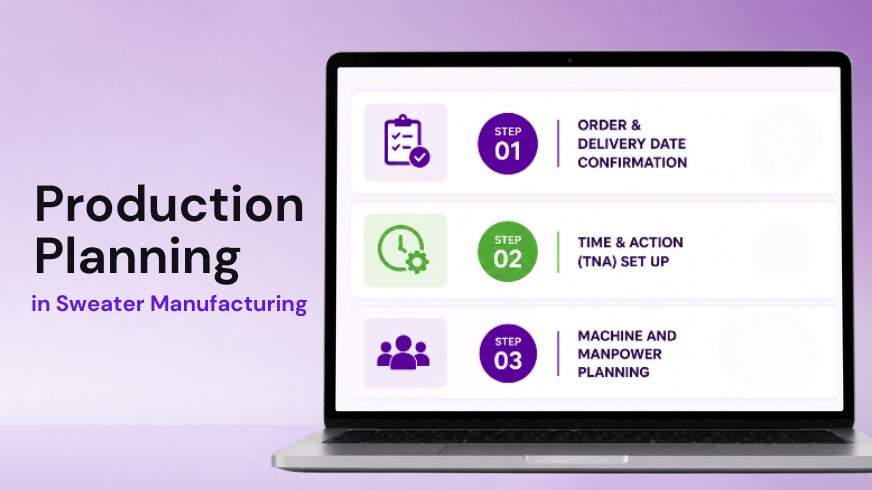
Step 1 — Confirm Order and Delivery Date
Production planning begins only after the bulk order is officially confirmed. Once the buyer approves the sample, all final specifications: yarn composition, color, machine gauge, and order quantity are locked in.
Then the merchandiser quotes a buyer on a delivery date favorable for buyer and the factory. This date can be revised, and the final date can be confirmed.
The delivery date drives everything as every step: yarn procurement, machine loading, and manpower planning is built backwards from it. If this date is not realistic from the start, the entire plan can fall apart.
Step 2 — Set Up Time & Action (TNA) Calendar
After the order is confirmed, a timeline is created for the production process, which is a Time and Action (TNA) Calendar.
TNA in sweater manufacturing is a crucial document needed to plan pre-production and production days for on-time delivery of orders. It is checked regularly, typically once a week, to make sure the plan is followed.
When creating a TNA, the merchandiser considers factory capacity, style complexity, yarn arrival time, logistics, holidays, shipment details, and buyer response times.
Step 3 — Plan Machines and Manpower
Once the TNA for an order is completed, it is time to understand the machine and manpower availability. The production manager estimates the required number of machines, machine run time, operators, and MUP workers for the order.
Based on available time and line capacity, the order may be planned across multiple production lines.
If no line has enough free capacity, the start date can be adjusted, and the planning timeline can be used to schedule upcoming orders without delays or overload.
Although PPC is critical, many sweater factories still manage it through paper records or spreadsheets. This makes planning more prone to errors, miscommunication, and even document loss. This calls for digital transformation in sweater manufacturing, including production planning.
A dedicated system is needed to connect production planning, shop floor execution, and other key sweater manufacturing operations. For this, an ERP is the right solution; but a generic ERP may be a costly investment. Thus, an industry-specific ERP like KnitOne fits better.
KnitOne- a tailored ERP for knitwear manufacturing, helps digitalize complete sweater factory operations, including Production Planning and Control. How? Let’s find out in the next section.
Confident in your present production planning to be efficient? Check out the 5 Signs to understand if sweater production planning needs a digital upgrade.
Role of KnitOne ERP in Sweater Production Planning
The KnitOne Intelligence Hub has a robust solution, “Production Planning and Control” which helps factories to centralize production planning.
With KnitOne’s PPC, factories can have:
- Better machine capacity visibility
- Improved manpower allocation
- Stronger inventory-production coordination
- Better WIP (work-in-progress) visibility and tracking
Eventually, with PPC, a sweater factory can witness the lowest frequency of delayed order delivery and better customer/buyer base.
Check out KnitOne PPC Module to understand its core features and functions.
Final Thoughts
Production planning directly affects how smoothly a sweater factory executes each order. A strong production planning and control (PPC) helps plan pre-production and production timelines, manage capacity, control delays, and deliver quality products on time.
Over time, with PPC, production managers can compare planned timelines with actual progress to identify gaps, bottlenecks, and recurring issues.
To make the sweater manufacturing planning process more accurate, factories need to move beyond registers and spreadsheets; they need to make a digital transformation with solutions like KnitOne ERP.
To be precise, KnitOne’s PPC module helps factory owners have a strong production plan and execute an order according to the set timelines.
With PPC and other modules of KnitOne, sweater manufacturers can have better operational visibility and make smarter decisions for smoother production, timely delivery, and long-term factory growth.
Why wait? Boost Profits with KnitOne’s Complete Operational Visibility.
Frequently Asked Questions
1. What does PPC mean in sweater manufacturing?
PPC stands for Production Planning and Control. PPC in sweater manufacturing is the main production reference plan that defines the timeline for pre-production, production, and post-production activities.
2. Why is PPC important for sweater manufacturers?
Production planning and control is important for sweater manufacturers because it helps knitwear factories have defined dates for various order production stages, which helps timely execution and never miss the committed delivery dates.
3. What are the main responsibilities of a PPC department?
The main responsibility of a PPC department is to define and determine production planning for various orders. For that, they need to plan machine capacity planning, allocate required manpower, schedule production, track daily production, and delay control.
4. How does PPC reduce production delays?
PPC reduces production delays by defining the timeline for order execution. This makes the production manager stay compliant and execute orders on time.
Further, the production manager can compare the target vs actual PPC to spot gaps and bottlenecks. This eventually helps improve upcoming production.
5. How does PPC help with machine capacity planning?
PPC helps with the machine capacity planning by checking machine availability along with the data of a machine’s runtime, downtime, and maintenance.
6. What is the PPC process in sweater manufacturing?
PPC process in sweater manufacturing includes major steps of 1) order confirmation, 2) TNA determination, and 3) plan manpower and machine usage.
7. Can ERP improve Production Planning in sweater manufacturing?
Yes, an ERP can significantly improve production planning in sweater manufacturing. With KnitOne ERP’s PPC module, manufacturers can organize, streamline, and improve entire production in a factory.