
It is great to see sweater manufacturers utilizing available digital technologies, whether hardware or software, for better productivity. In fact, most of them understand why an ERP is important and how it can help ease sweater manufacturing operations.
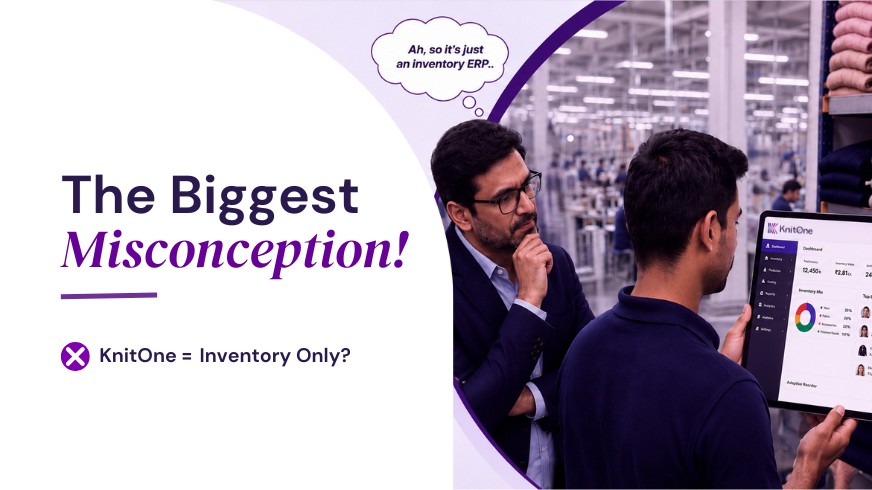
However, a narrative that “ERP is equivalent to inventory” is becoming popular among sweater manufacturers. But the catch is — inventory is only the starting point of an ERP. Since inventory solves stock-in-and-out visibility, it becomes highly visible to managers and owners. This hence strengthens their idea that ERP equals inventory.
Interestingly, 89% of companies agreed that accounting is the most critical ERP function, while 67% pointed to inventory and distribution. So, it is no surprise that ERP is often considered synonymous with accounting and inventory.
Just like every other ERP, KnitOne is also constantly perceived as a mere inventory-handling system. But the system is much bigger and more capable.
This blog focuses on making it clear that KnitOne is more than inventory. It offers a strong digital solution for knitwear manufacturing operations.
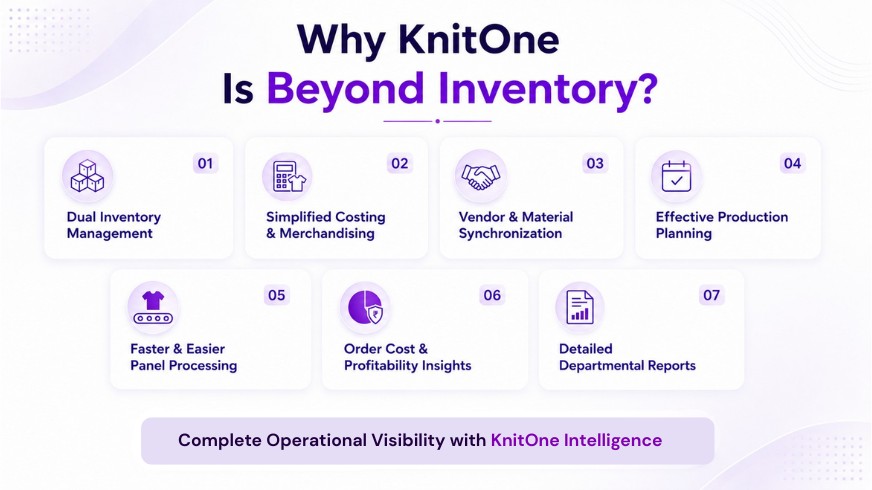
Why KnitOne Is Beyond Inventory?
KnitOne is a tailored ERP for sweater manufacturers that includes solutions for major knitwear production operations. It obviously supports inventory management, but it does not stop there.
KnitOne provides complete operational visibility, which is only possible by connecting inventory, merchandising and costing, production, shipment, and reporting.
To make it clear that KnitOne is not just inventory software, we have explained its major capabilities below.
1. KnitOne Has Two Robust Inventories
KnitOne is equipped with two inventories: 1) General Inventory and 2) Yarn Inventory. Why?
Because in sweater manufacturing, yarn and other items are often tracked in a single inventory. However, in such a setting, yarn — the core and complex aspect of knitwear production — cannot be handled effectively.
Understanding the need for complete yarn movement traceability, KnitOne has built a separate inventory just for yarn: Yarn Inventory.
Along with yarn master data such as composition, count, color, etc., yarn inventory records incoming, usable, locked, utilized, remaining, obsolete, and decommissioned yarn details. This helps inventory managers, production managers, and even owners understand actual yarn usage, yarn rejection, and yarn wastage.
Meanwhile, general inventory covers typical inventory tracking and procurement processes for trims, accessories, assets, etc.
Together, KnitOne’s General Inventory and Yarn Inventory help record and track consumption across the entire factory.
2. It Brings Ease for Merchandisers
Merchandisers manage buyer communication and play a key role in preparing accurate order costing. Although experienced, they may still face costing errors, which can be costly, especially in luxury knitwear production.
KnitOne helps merchandisers solve costing concerns by supporting accurate costing with only a few cost-related inputs. With its other modules and features, merchandisers can also communicate with buyers, coordinate internally, and support timely production and shipment.
3. Vendors and Materials Stay in Sync
For an order to progress, confirmation alone is not enough. Vendor coordination, material availability, planning, and production must be aligned.
If communication and follow-up with vendors become weak, it can result in delays in supplies, production, and higher costs. This eventually affects supply chain forecasting.
KnitOne offers Vendor Management, which maintains a master data of approved vendors and allows purchases only from authorized suppliers. Vendor-related payments and invoices can also be handled through this module.
4. Planning Reaches the Production Floor
In many sweater factories, production does not go as planned because of weak planning. Not only that, but reactive and poor planning can overburden machines and manpower while increasing the possibility of material wastage.
KnitOne helps factories adopt adaptive production planning by defining ideal TNA, buyer delivery dates, and order execution priorities.
The best part is that it allows factory owners to plan machine downtime instead of dealing with sudden breakdowns and costly downtime.
5. Easier and Faster Panel Processing
A sweater is made by linking panels such as the front, back, sleeves, collars, pockets, and other components.
When knitted panels are not tracked clearly, they can get misplaced, delayed, mixed, or held between stages. This affects production output, finishing timelines, and shipment readiness.
KnitOne supports digitalized SFG tracking from knitting to linking, finishing, and packaging. This tracking gives more clarity on where each panel is, what has moved, and what is still pending.
6. Profits Brought by Orders
A factory may be busy executing orders, but does that guarantee profit? No. For that, each order’s contribution and cost need to be studied.
Usually, preparing individual order reports takes days because estimated costs and actual costs must be traced manually. But with KnitOne, such a report can be extracted with the click of a button.
7. Reports Show Where Action Is Needed
In many factories, reports are either prepared late or scattered across departments. By the time owners get the full picture, delays, WIP buildup, material gaps, or performance issues may already be serious.
KnitOne brings these factory activities into clearer reports and analytics covering inventory, planning, production, SFG movement, warehouse, order performance, and profitability.
Wondering how KnitOne is capable of offering these features to sweater manufacturers? It has its own solution system called KnitOne Intelligence. Let’s understand how this intelligence helps track, record, and control operations.
How Can KnitOne Intelligence Transform Sweater Factory Operations?
KnitOne Intelligence is a solution ecosystem by KnitOne for digital transformation in sweater manufacturing. It helps factories gain better control over operations and costs.
KnitOne Intelligence offers the following benefits for knitwear manufacturing factories.
1. Stronger Department Coordination
Sweater manufacturing processes are not linear; they are highly interconnected. Therefore, interdepartmental clarity and collaboration are a must.
Even a small inventory issue can affect costing, merchandising, planning, and production. KnitOne helps reduce this risk through controlled workflows, approval-based material movement, and better visibility across departments.
For more details, read our blog on the reality of collaboration in knitwear manufacturing.
2. Modernized SFG Tracking
Losing panels on the shop floor not only wastes time but also creates chaos. With KnitOne, panels can be tracked more clearly across stages. Manufacturers can also opt for either QR or RFID-based SFG tracking for maximum visibility on the shop floor.
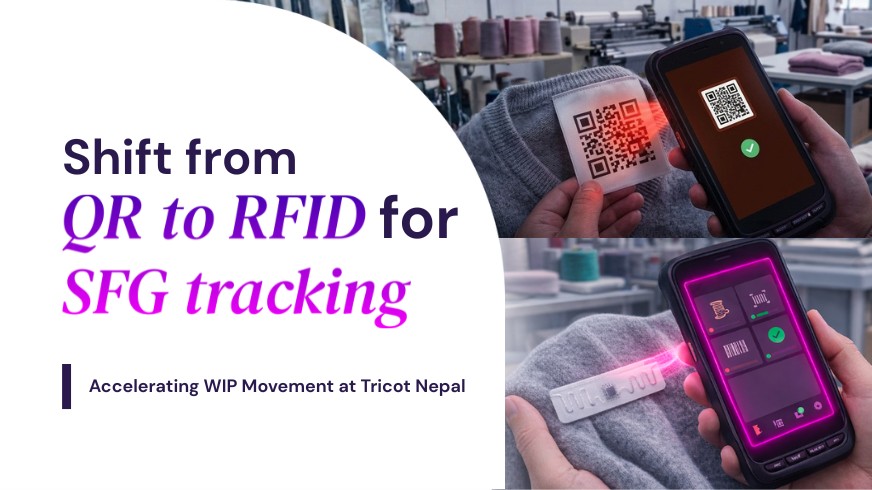
Read our case study on Shift from QR to RFID for SFG Tracking: A Sustainable Approach at Tricot Nepal.
3. Streamlined Order Execution and Delivery
With Production Planning and Control, production managers can estimate the most viable delivery date along with other key dates for TNA.
When the plan is followed properly, delivery dates are less likely to be missed, and a drastic decrease in last-minute production pressure becomes noticeable.
Along with this, sweater manufacturers can get a clear picture of in-production status, WIP status, and packaging without waiting hours or days for manual updates.
5. Order-Specific Cost Details
KnitOne’s Order Profitability provides every cost detail, particularly of yarn, production, overhead, rejection, and wastage.
With only a few inputs, owners and managers can see the contribution earned and the money lost. Further, they can compare their expected vs. actual costs for the order and reflect on what went wrong.
For detailed information on internal/factory rejection cost, you can read our blog Cost of Rejection.
6. Faster Decision-Making
With KnitOne’s robust tracking and detailed reports on knitwear operations, it becomes easier to spot unusual patterns or bottlenecks in the factory.
With such insights, necessary interventions and decisions can be made to achieve maximum productivity without exceeding estimated costs.
In simple terms, KnitOne Intelligence helps sweater factories see what is happening in the factory, what needs to be changed, and what profit can be achieved.
Final Thoughts
The biggest misunderstanding about KnitOne is that it is an ERP, like generic ERPs, which are often seen only as inventory management systems. Moreover, KnitOne is more than inventory!
Inventory matters as it is a crucial part of KnitOne Intelligence. Both general and yarn inventories connect the entire knitwear operation, including merchandising, vendor and order management, production planning, production, delivery, and shipment.
With our intelligence, sweater manufacturers can see the full factory picture, not just available stock and finished goods. This helps them understand gaps, delays, and bottlenecks and develop better strategies to drive impact through higher productivity and profits.
Why wait? Boost profits with KnitOne’s complete operational visibility.
Frequently Asked Questions
What is KnitOne Intelligence?
KnitOne Intelligence is a connected solution hub for factory operations in sweater manufacturing. It includes:
- Yarn Inventory
- General Inventory
- Procurement
- Production Planning and Control
- SFG tracking
- Merchandising
- Order Profitability
Is KnitOne only for inventory management?
No, KnitOne is not only for inventory management; it is a complete ERP for knitwear manufacturers covering solutions for merchandising, production planning, vendor and order management, SFG tracking, warehouse management and order-performance visibility.
What is SFG tracking in KnitOne?
SFG tracking in KnitOne refers to tracking panels’ journey into becoming a garment/sweater. Here, you can access either QR or RFID based SFG tracking.
Can KnitOne help factory owners understand order performance?
Yes, KnitOne helps factory owners understand order performance, how much the order earned, and the cost for the factory, with its order profitability module.