
For most sweater factories, the off-season is the quietest stretch of the year.
Knitting machines run below capacity, order books thin out, and the floor waits for the next round of buyer confirmations.
Many factories treat these months as a pause and simply wait for the next year’s peak season. But that wait costs a lot. Moreover, last season’s late shipments, yarn shortages and large WIPs persist till the upcoming peak season. These issues often become larger than before.
But the good thing about the off-season is that it can become an opportunity for factories to transform their way of operating. How? We have covered that in this blog.
But first, let’s understand what the off-season is in knitwear manufacturing.
What the Off-Season in Sweater Manufacturing
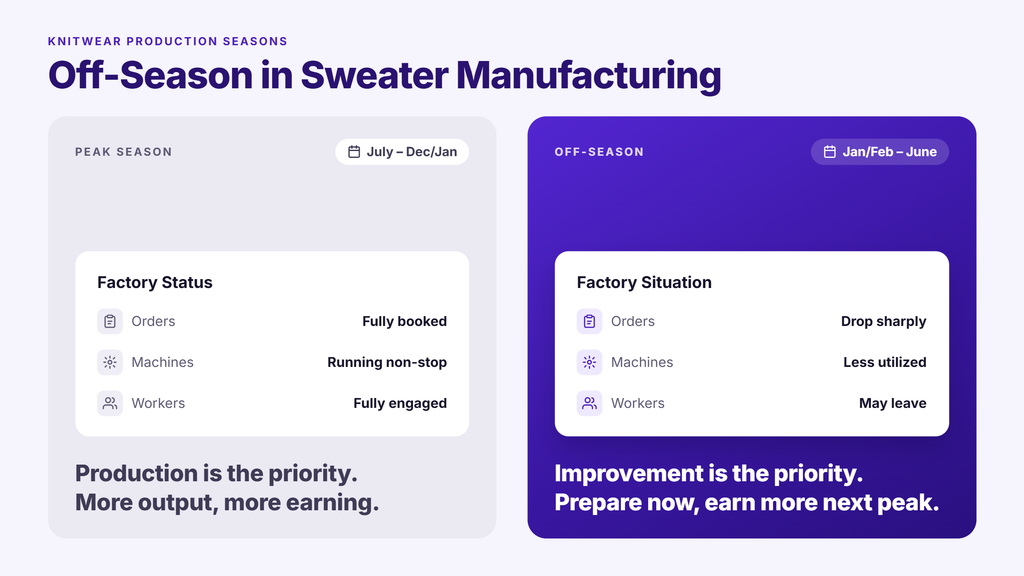
An off-season in sweater manufacturing refers to the slower production months, typically from spring to mid-summer (February through June).
The off-season for knitwear factories varies by region; it typically runs from January to June in Bangladesh, and from February to July in India and Europe.
Although the off-season in sweater manufacturing is a time when there is a heavy drop in total manufacturing volume, it does not mean total absence of production.
It’s just that, in the off-season, the factory is open, but its machines are largely underutilized.
Impacts of the Off-Season on the Knitwear Factory
Off-season is one of the given states for factories; however, it does bring some effects. Let’s look into some of the major ones:
- Machines may be partly unused, but rent, salaries, power, and loan repayments continue. It means costs keep adding without output.
- Many workers leave because of thin work. Skilled workers: knitters, linkers, menders, and finishers can especially move to other jobs. The factory has to rehire and retrain just before the next rush.
- Late shipments, yarn shortages, and WIP pileups from the last peak can go unexamined as the team often looks at them when the next crisis arrives.
Production slows in the off-season, but the factory’s direction for the coming year is often set in these quiet months.
5 Reasons the Off-Season Is the Biggest Opportunity for Knitwear Manufacturers
In the off-season, orders are fewer, and the pressure on the factory floor eases.
This quieter period gives management the time to understand the factory more closely and find solutions that improve productivity for the season ahead.
Let’s understand what action to take when it is lean or off-season for sweater factories.
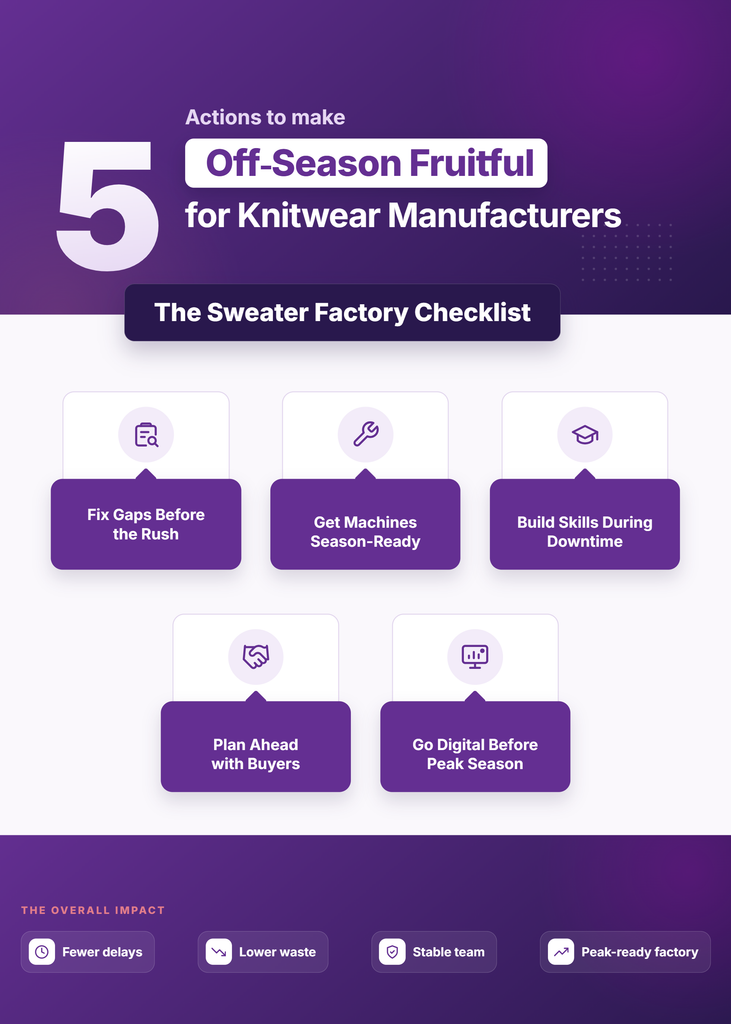
1. Time to Diagnose, Not Firefight
In the knitwear industry, order placements are made from February to May. After that, decisions such as receiving yarn, planning production lines, and fixing the shipment dates are made.
With a TNA schedule in hand, production is completed from August to October. The pressure to deliver quality products on time persists. But the off-season doesn’t bring such pressure.
With fewer orders on the floor, the team can finally review last season’s records and trace each delay, rejection, and shortage back to its cause.
Additionally, manufacturers can consider the “vital few” concept of Joseph Juran. Meaning, figure out the minute causes behind most of the losses. Factories can find and fix those causes so that when the factory enters the next peak, it has fewer crises to firefight.
2. Machines Are Free for Maintenance
Flat-knitting machines are produced by Sheima Seiki, Cixing, and many other companies. These high-tech different-gauge machines continuously run through the high season to knit panels of different styles.
Without proper capacity planning, these machines could face more downtime and require extra servicing, calibration, and part replacements.
The slack season for a sweater factory can be an optimum time to provide the much-needed machine care and maintenance.
3. Operators Can Train and Cross-Skill
In sweater manufacturing, skilled people are often a tighter constraint than machines.
According to global labour organisations, labour turnover in apparel manufacturing ranges from 2% to 10% a month, and from 26% to over 60% a year, depending on the producing country. Wages are one of the main reasons workers leave.
Shop floor workers are usually paid by the piece, so fewer orders mean lower earnings. As a result, some skilled operators move on, and the factory has to rehire and retrain just before the next rush.
Factory owners can, however, turn the quiet months to their advantage. Supervisors can run paid training for new operators and cross-train existing ones across sections. Paid training gives skilled workers a reason to stay, and a multi-skilled team handles peak-season pressure far better.
4. Buyers Are Planning Next Season
The off-season may bring up a quiet knitting floor, but it doesn’t mean buyers are idle.
While factories wait for orders, buyers are busy planning the next season. They review last season’s sales, finalize new ranges, and shortlist suppliers.
Interestingly, the sweater selling season has also grown longer. A longer season means more styles and deliveries to plan, so buyers start sourcing earlier. As a result, factories that use the off-season to prepare are the first to catch buyers’ attention.
To be ready when buyers reach out, factories can use this lean season to:
- Check in with existing buyers about their upcoming plans and best-selling styles.
- Keep sampling capacity free to handle development requests quickly.
- Prepare compliance records and capacity details for supplier reviews.
5. The Right Window to Digitalize
The off-season is the best time for factories to change how they operate.
Many knitwear factories run advanced knitting machines, yet their daily records still live on paper registers and notebooks. When a yarn issue, a machine breakdown, or an output count is missed or copied wrongly, small gaps quietly turn into shortages, losses, or delays.
Thus, they need to digitize record-keeping orders, yarn, production, and sales from paper to Excel. This makes data easier to store, search, and share; errors are easier to spot, and records are less likely to be lost.
But digitizing only changes where records are kept, not how the factory works. Each department still keeps its own files; entries are made after the work is done, and figures often don’t match across sheets.
That is where digital transformation through ERP – a connected system makes the difference. It tracks every order from start to shipment and gives clear visibility across processes.
Why not implement an ERP during peak season?
During peak season, employees are busy; they have no time to learn about a new system. Any disruption puts shipments at risk. Hershey’s ERP failure is a well-known example. Its new system went live during its busiest season in 1999, leaving around $100 million worth of orders unfulfilled.
But why choose ERP for Sweater Manufacturers?
Here’s the truth: not every ERP fits into a sweater factory.
A generic ERP overlooks what makes knitwear different, from gauges and yarn shades to multi-stage production and wastage. That is why, when weighing generic vs industry-specific ERP, sweater manufacturers are better served by an industry-specific system built for knitwear.
Even then, the choice isn’t easy. Many ERP for garment manufacturing are marketed as ERP systems for knitwear manufacturing. However, they only have a few features catering to sweater production. Choosing one of those ERPs leads to heavy customization and higher ERP implementation costs. Fortunately, KnitOne removes that hassle.
KnitOne is a tailored ERP for sweater manufacturers, with a particular focus on flat-knit production. It brings together a set of robust modules known as KnitOne Intelligence. Some of the core modules are:
- Production Planning and Tracking
- Yarn Wastage, Yarn and Buyer Rejection
It connects merchandisers, the shop floor, and owners. Overall, with KnitOne, sweater manufacturers gain complete operational visibility: from yarn to growth, all in one view.
Final Takeaways: The Next Peak Is Won in the Off-Season
The off-season in sweater manufacturing comes every year, usually from February to June.
This lean season is the one time a factory can look closely at its problems, shortcomings, and gaps. Unless these are understood and fixed, late shipments, yarn losses, rejections, and WIP pileups can continue into the next peak.
Manufacturers can use the off-season to:
- maintain machines
- train operators
- review last season’s records
- forecast next year’s production and sales.
It is also the right time to move beyond registers and spreadsheets. Factories can implement an ERP for sweater manufacturing, such as KnitOne.
Why waste this off-season? Stay prepared for next peak season and boost profits with KnitOne’s complete operational visibility.
Frequently Asked Questions (FAQs) About Off-Season in Sweater Manufacturing
What is the off-season in sweater manufacturing?
The lean or off season in sweater manufacturing is the annual period when global demand for winter clothing drops drastically.
When is the off-season for sweater manufacturers?
The lean period in sweater manufacturing typically spans from January or February to June, right after the winter shipments end and before the next production cycle begins.
When is the off-season and peak season for knitwear factories in Bangladesh?
The off-season falls between January and June when bulk winter orders dry up, and factories switch to spring sampling.
The peak season for knitwear factories in Bangladesh runs from July to December to manufacture and ship autumn/winter sweaters for the US and European markets.
When is the off-season for knitwear factories in India?
The peak season for sweater factories in India occurs from August to January due to the high domestic festival demand like Diwali alongside Western export shipments.
The off-season runs from February to July as domestic winter demand drops and factories transition to basic cotton knits.
When is the off-season and peak production season for knitwear factories in Europe?
The peak production season for European knitwear factories spans from August to January for the production and delivery of heavy winter knits.
European knitwear off-season takes place from February to July, when bulk winter production stops and shifts toward premium, lightweight spring and summer collections.
What happens in the sweater manufacturing off-season?
The following things happen during the off-season in the sweater manufacturing industry:
- mass production slows down dramatically
- utilize this downtime for research and development
- create new design samples
- negotiate future buyer contracts
- perform thorough machinery maintenance.
Is the lean season a threat or an opportunity for knitwear manufacturing?
The off-season in knitwear manufacturing is both a threat and an opportunity because it creates severe cash flow crunches and the risk of skilled labor migration.
However, it also provides a quiet downtime for strategic planning, technology upgrades, and workforce training without production pressure.
How can a sweater factory survive the lean season?
A sweater factory can survive the lean season by:
- shifting production to lightweight spring or summer knitwear using fine-gauge machines
- offering price discounts to buyers to secure low-margin orders that cover fixed overhead costs
- buying yarn at lower market rates to stock up for the next peak season.
How can sweater factories use the lean season to improve the business?
Sweater factories can use the lean season to improve their business by:
- conducting workshops on quality control and lean manufacturing tools
- reviewing and repairing layout bottlenecks on the factory floor
- installing automatic jacquard machines to modernize infrastructure.
What are the steps to prepare a knitwear factory for the next peak season?
The steps to prepare a knitwear factory for the next peak season are as follows:
- Review last season’s registers and Excel sheets
- Identify gaps in orders, yarn, WIP, and quality.
- Calculate real capacity and forecast.
- Digitalize processes where required
Why is the off season a suitable time to implement an ERP system for knitwear factories?
The lean season is the most suitable time to implement an ERP system for sweater manufacturers because:
- employees have the necessary free time to attend software training without active order pressure
- any initial data entry errors can be fixed calmly without threatening urgent shipment deadlines.