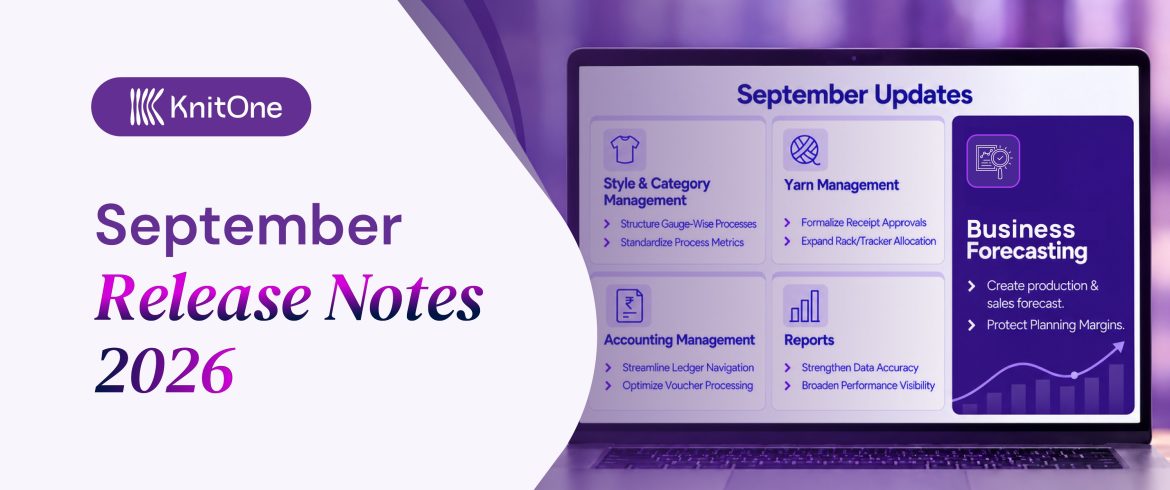

In September, team KnitOne focused on strengthening the structure behind day-to-day operations. Here, major improvements were made across Style and Category Management, Yarn Management, Accounting, Reporting, Forecasting, Vendor workflows, and Warehouse operations.
Moreover, the team completed 73 major tasks and resolved 79 bugs, improving both system capabilities and operational reliability.
Let’s get into the details of the improvements made this month.
What Are the Major September Updates in KnitOne?
Below is a brief explanation of the most significant updates across different modules, along with their operational impacts.
1. Robust Style & Category Management
Style Management was updated to provide more detailed process-level information.
The category structure itself was also reorganized. Master Category and Sub-Category were separated into dedicated tabs, with the number of Sub-Categories displayed against each Master Category.
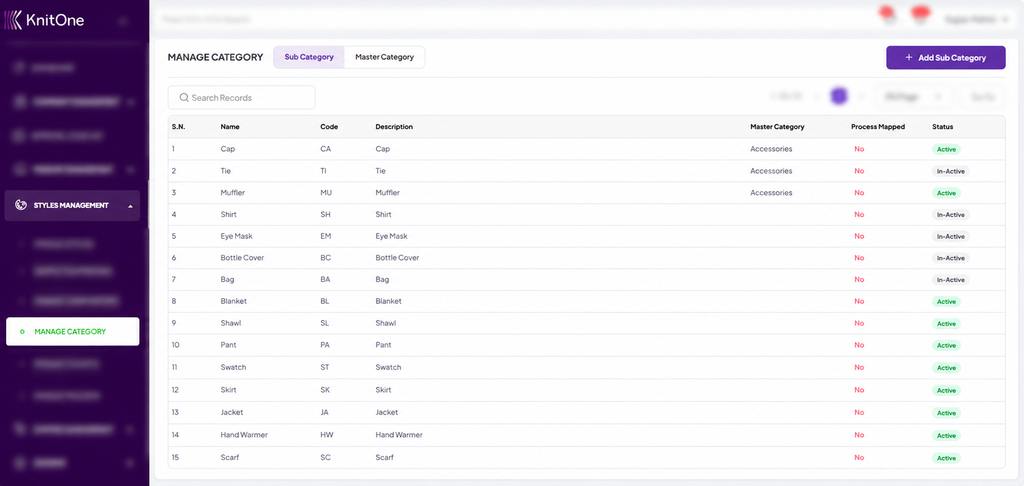
A “Has Sleeved?” field was added to the Category creation and editing screens, and permissions were introduced for Master Category access
In addition, Category Management received a broader structural update. Standard and Effective columns per process was included.
Standard and Effective values were added for each process, allowing both values to be maintained separately within Style Management.
The Process Data Grid was redesigned with processes arranged as rows and gauges as columns. This allowed Knit Minutes, SAM Value, and Rate to be maintained against the relevant process and gauge.
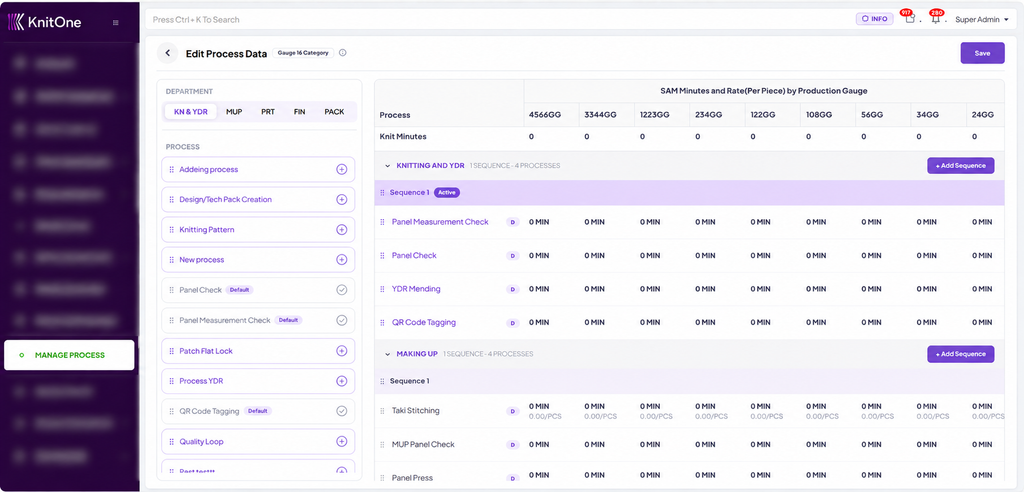
Rate Total was added to the Manage Category Process page. Default process rows are now created for each department. Along with this, a read-only gauge-wise view was added along with live totals on the edit screen.
Impacts:
- Faster setup and maintenance of production process information
- More accurate calculations across gauges and manufacturing processes
- Easier review and comparison of process-level information
- Greater consistency across category structures and configurations
- Better control over access and master data
2. Improved Yarn Management & Traceability
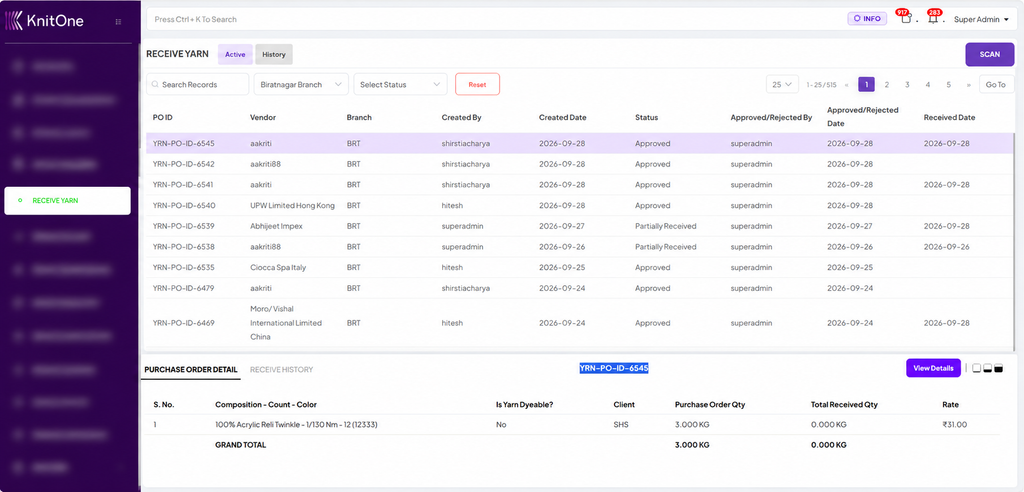
Yarn receiving was strengthened with a dedicated approval workflow, introducing an additional review stage before receiving yarn is finalized.
Yarn storage and tracking were also made more flexible. The same yarn lot can now be assigned across multiple trackers and racks, allowing one lot to be represented across different physical storage locations without losing its lot-level identity.
In addition, PO ID visibility was added to Receive Details, making it easier to connect received yarn with its originating purchase reference.
Yarn transaction tracking was further refined through improvements to the Yarn Ledger. The previous “Changed By/From” and “To” references were replaced with clearer Initiator and Receiver fields. The Transaction ID was added to make individual yarn movements easier to identify.
Impacts:
- More reliable review and recording of incoming yarn receipts
- Stronger control over yarn receiving and inventory confirmation
- Better visibility of yarn lots across multiple storage locations
- Easier linkage between purchase orders and received yarn
- Clearer identification of initiators, receivers, and individual transactions
3. More Defined Accounting & Voucher Workflows
Accounting received several practical improvements to make everyday financial work easier. An Employee Ledger was added under Sundry Creditors, and a separate Bank Charges entry was introduced in voucher processing.
Ledger handling was improved with search by Ledger Code, and ledger codes were added to the Trial Balance, Profit & Loss, and Balance Sheet. Also, Invoice IDs were also linked with the fiscal year for clearer identification.
Voucher completion now allows users to print or skip printing. The Posting Date is clearly shown and sorted in the voucher list. Remarks and Narration are also more visible, making voucher information easier to review.
Also, Optional TDS and VAT fields were added at the voucher line-item level.
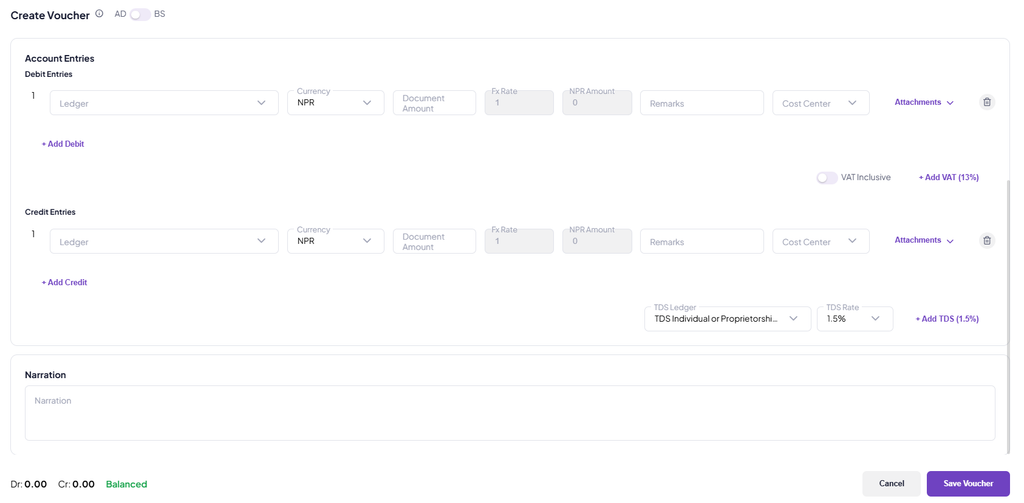
Currency handling was also updated. Currency symbols were corrected in reports, and the FX rate is now calculated automatically based on the Posting/Document Date, while users can still edit the calculated rate when required.
Along with that, POS Sales which are not reflecting on accounting module, is now made visible.
Impacts:
- Easier management of employee and bank-related accounting entries
- Faster voucher processing with clearer dates, narration, and printing
- Quicker ledger searches and clearer financial report references
- More flexible entries through line-level TDS and VAT
- Clearer invoice identification across different fiscal years
- More accurate currency handling with flexible FX rate adjustments
Go through KnitOne’s Accounting Module for further information
4. Clearer Reporting & Operational Visibility
Numerous improvements were made on various reports, especially in mismatches in FG Stock Movement, Yarn Stock, Yarn Ledger, Department Summary, Weekly Summary, and Daily Summary reports.
The Consolidated Weekly Yarn Report was updated with Weighted Average, while the Weekly Summary was revised to use weekly date filters and include YTD Average Knit Day and Average Pack Day. YDR data was also added to Daily and Weekly Reports.
Additionally, Active Order logic was aligned between the Dashboard and Consolidated Reports to ensure consistent order-status reporting.
Impacts:
- More reliable operational reporting for management review.
- Better consistency between dashboards and reports.
- Greater visibility into yarn and YDR activity.
Also Read Our Blog: What are the Important Reports for Sweater Manufacturers?
5. Advanced Business Forecasting & Planning
The Forecast aspect of annual planning now supports creating, editing, listing, importing, exporting, approving, and rejecting forecasts.
When a new forecast is created, the system automatically brings in the previous forecast as a reference.
Forecast data can now be imported from and exported to Excel, allowing forecast information to be transferred between KnitOne and Excel files. Also, approved forecasts can now keep their original margin.
In addition, The Gross Operating Profit (GOP) percentage can now be entered, and the required CMTP is calculated automatically to match the target margin.
Impacts:
- More structured forecasting from creation to approval.
- Better control over approved planning values.
- Reduced manual margin calculations.
- Greater consistency between planning assumptions and costing.
6. More Defined Vendor & Purchase Workflow
Vendor Invoice processing was expanded to handle more complex purchasing scenarios.
Vendor invoices can now be created against multiple PO/GRNs. A dedicated Posting Date field was also introduced while creating vendor invoices.
Also, configured exchange rates and payment terms are automatically filled in the Vendor Invoice, along with a suggested payment due date. These can still be edited if needed.
Relevant purchasing references such as GRN Invoice Number, PP No., and TTLC No. Are made available when selecting PO/GRN information on invoice line items.
Impacts:
- More flexible vendor invoice processing.
- Better linkage between invoices and purchasing documents.
- Improved payment-term visibility.
- Stronger traceability across procurement transactions.
7. Improved Warehouse Management
Add, Edit, and Delete functionalities were enhanced in the Warehouse module while also specifying associated permissions and mandatory field indicators.
A Recent Transactions view was also introduced in Warehouse Inventory for quicker access to recent FG movements.
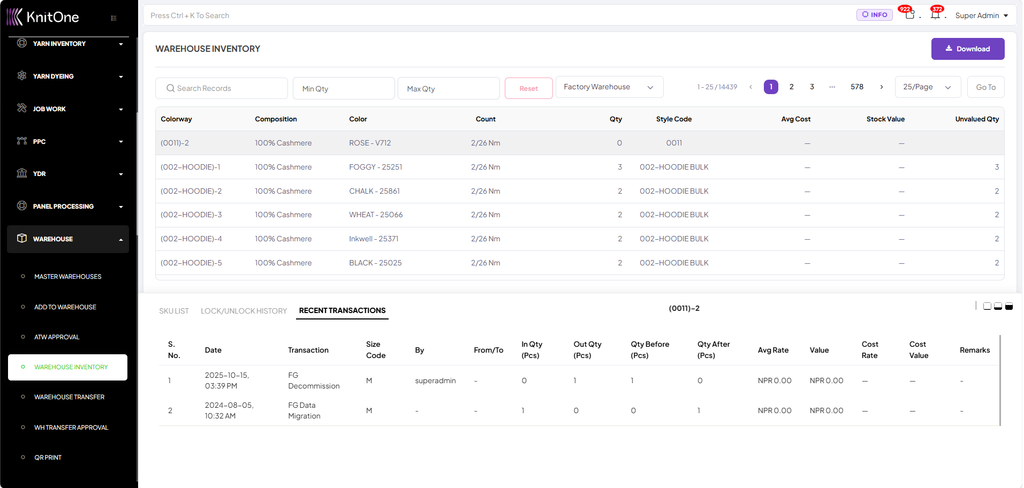
Also, multiple warehouses can now be assigned to a single user.
Impacts:
- Better control over warehouse access.
- Easier management of multiple warehouse locations.
- Faster access to recent inventory activity.
- Improved accuracy in warehouse visibility.
Other Important Updates
Several additional improvements were delivered across supporting modules:
- A zero-value GRN restriction was introduced to prevent Goods Receipt Notes from being created with zero value.
- An additional configuration section was added to PPC Configuration.
- PPC Summary reporting was refined to show the relevant packing balance records.
- YDR received an improved UI design along with workflow for closing knitting orders when a process is not mapped.
- Master Search for shortcuts for both Request Yarn and YDR Yarn Requests menu was created.
- Multiple Payment Terms with installments were introduced for Sales and Payment workflows.
- Costing workflows received fixes and support for editing/revising costing.
- Sales Invoice and Client Payment workflows received reliability improvements.
- Accounting reports can now be downloaded, with the downloaded information aligned with the on-screen view.
Bug Fixes and Improvements
Across the September release, Team KnitOne resolved 79 bugs. Some of the key fixes include:
- Style Management: When selecting an existing style, the Linked Client was automatically populated, while unnecessary Confirm and Cancel buttons were displayed in the file upload dialog.
- Item & Yarn Receiving: Issues with quantities after cancellation, receiving approvals, total-value calculations, yarn receiving history, and duplicate lot handling were resolved.
- Yarn Inventory: Problems with tracker searches, stock-report figures, yarn decommission validation, lot-detail filtering, and rack/tracker handling were corrected.
- Accounting & Vouchers: Problems encountered while editing vouchers and unexpected changes to entered voucher amounts were resolved.
- Sales & Client Payments: Invoice numeric overflow issues were resolved, while missing invoices in Client Payment Settlement were corrected.
- Company Management: Issues affecting Manage Users and Manage Employee functions were addressed to ensure user and employee information could be managed correctly.
- Forecasting & Planning: Issues affecting forecast validation, client and season searches, order closing, Annual Planning filters, forecast visibility, and planning search functions were corrected.
- Company Management: Issues with duplicate password-reset options and employee document preview alignment were corrected.
Final Takeaway
KnitOne’ September’s releases notes depicts that major improvements and updates were made across six major areas: Style & Category Operations, Yarn Management, Accounting & Voucher Workflows, Reporting, Forecasting & Planning, and Vendor & Warehouse Operations.
Across September, KnitOne was further strengthened with updates that improved data setup, inventory handling, financial processes, reporting, planning, and day-to-day operations.
Together, these updates make KnitOne Intelligence a more structured, reliable, and production-focused brain behind KnitOne- the best ERP for sweater manufacturers.